


News center
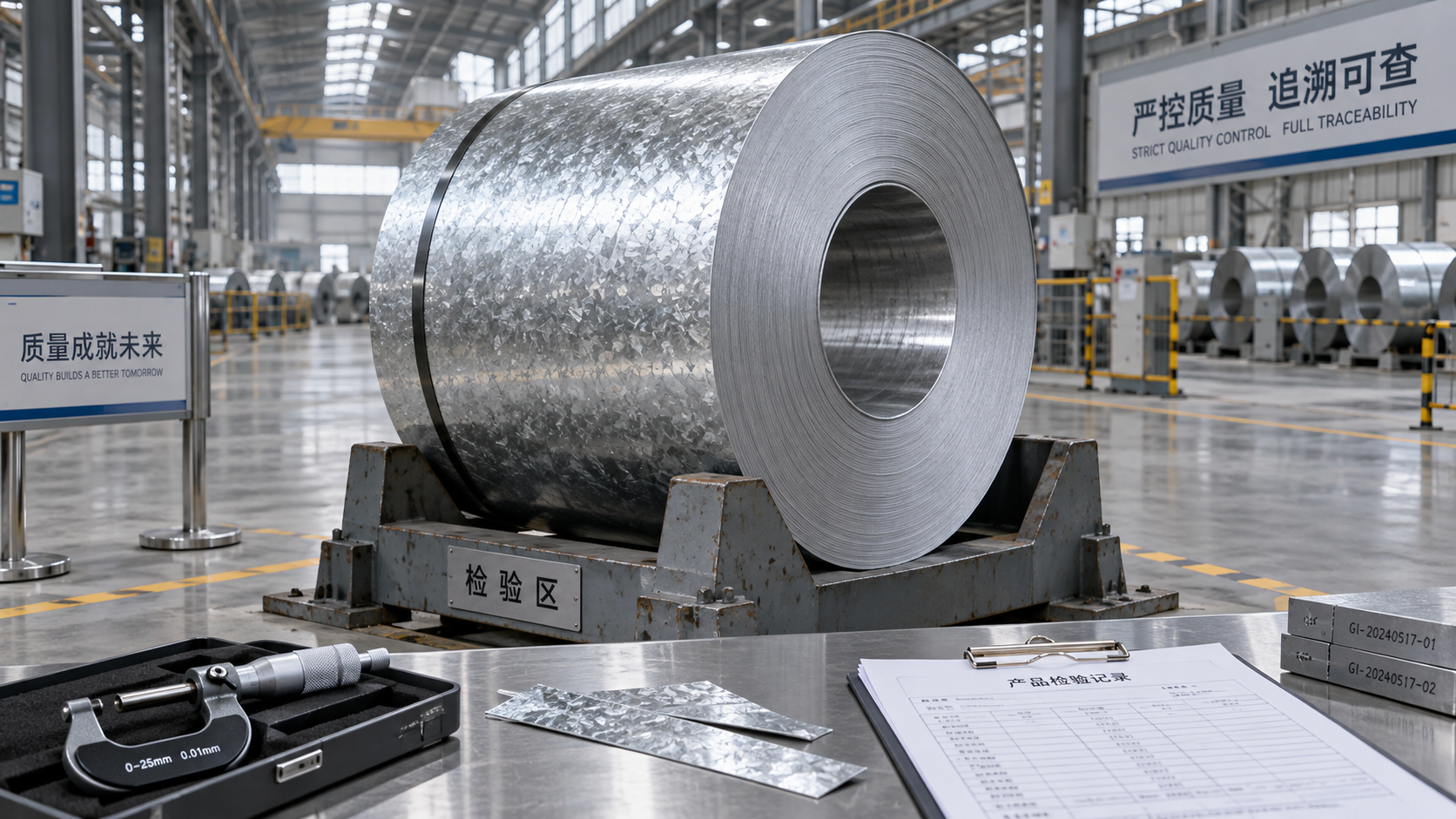
When sourcing prime hot dipped galvanized steel coils, what does “prime” actually guarantee? For procurement teams, the term generally means first-quality material supplied to agreed specifications, rather than secondary or downgraded stock. However, the label alone does not confirm a particular steel grade, zinc coating mass, surface finish or forming capability.
That distinction matters when two quotations look almost identical. Both may say “prime galvanized coil,” yet one could specify a lighter zinc coating, a different base steel or a wider thickness tolerance. Understanding what sits behind the word helps buyers compare offers fairly—and avoid discovering the difference after the coil reaches the processing line.
“Prime” describes quality status, not a complete specification
In steel trading, prime generally identifies material represented as meeting the applicable order requirements. Those requirements should cover the product standard, steel grade, dimensions, coating and other agreed acceptance criteria. Prime is not, by itself, a universal technical grade or an independent certification.
A prime coil can still have normal manufacturing variations permitted by its specification. Depending on the ordered surface quality and delivery conditions, minor appearance differences or certain surface imperfections may be acceptable. “Prime” should therefore not be interpreted as “visually flawless at every point along the strip.”
It also does not mean “the highest available specification.” A general-purpose forming grade with a relatively light zinc coating may be prime if it meets the order. A higher-strength coil with a heavier coating may also be prime. Their suitability depends on the application, not on the shared label.
Surplus stock is not automatically secondary. Equally, a coil should not be accepted as prime merely because its outer wraps look clean.
What the galvanized coating adds—and what it cannot promise
Hot-dip galvanized sheet is produced by passing prepared steel strip through a molten zinc bath on a continuous coating line. The resulting coating provides a barrier against the environment and sacrificial protection to exposed steel in suitable conditions.
This makes galvanized coil useful for construction components, machinery housings, steel profiles, transportation parts and hardware. Nevertheless, corrosion performance depends on more than whether the material is prime. Zinc coating mass, atmospheric exposure, moisture retention, cut edges and component design all influence service behavior.
Prime does not mean rust-proof or maintenance-free. Even conforming material can develop wet storage stain if moisture becomes trapped between tightly packed layers. Severe exposure, standing water or contact with incompatible materials can also shorten coating life.
For procurement, the useful question is not simply “Is it prime?” but “Is this prime material specified appropriately for our process and environment?”
How to read a quotation for prime hot dipped galvanized steel coils
A quotation becomes meaningful when its descriptions can be checked against an order and an inspection record. Before comparing prices, align the following technical details.
Product standard and steel grade
Common references include ASTM A653/A653M, EN 10346 and JIS G 3302. These standards provide frameworks for continuously hot-dip-coated steel products, but their grade designations and requirements are not interchangeable by name alone.
Specify the applicable standard, edition where required, and exact grade. A coil intended for simple bending may not meet a demanding drawing operation. A structural application may require defined yield strength and elongation rather than a general commercial-quality description.
If a supplier proposes an alternative grade, ask for a comparison of the relevant mechanical properties, chemical requirements, coating provisions and tolerances. “Equivalent” needs a technical basis, not just a statement on the quotation.
Zinc coating designation
The coating designation identifies a requirement separate from the base steel grade. Under commonly used systems, Z275 refers to a nominal total coating mass of 275 g/m² across both surfaces. ASTM G90 is often compared with Z275 because its total coating mass is approximately 275 g/m², but the applicable standards and acceptance rules must still be checked.
Do not interpret a total coating mass as the amount on each side. Also, coating mass is not the same measurement as coating thickness. Testing methods, sampling positions and acceptance limits belong in the specification when they are important to the application.
Thickness, width and permitted variation
A nominal size alone is not enough. Confirm the applicable thickness and width tolerances, edge condition, and whether the quoted thickness means base metal thickness or total coated thickness. That distinction can affect weight calculations, material yield and forming behavior, especially for thin products.
For narrow slitting or automated feeding, other details become important: coil inside diameter, maximum outside diameter, coil weight, camber and flatness requirements. These are practical production constraints, not optional purchasing details.
Surface finish and post-treatment
Regular spangle, minimized spangle and other surface conditions describe appearance and processing characteristics—not a ranking from low to high quality. A visible zinc pattern is not proof of a heavier coating, while a smoother-looking surface is not proof of better corrosion resistance.
Ask whether the coil is skin-passed, oiled, passivated or supplied with another treatment. For painting, adhesive bonding or sensitive environmental requirements, confirm compatibility with the intended downstream process. Never assume that every galvanized surface is ready for immediate painting without preparation.
Inspection should connect the paperwork to the physical coil
A reassuring certificate is useful only when it can be linked to the delivered material. Start with coil identity, then work through the specified characteristics.
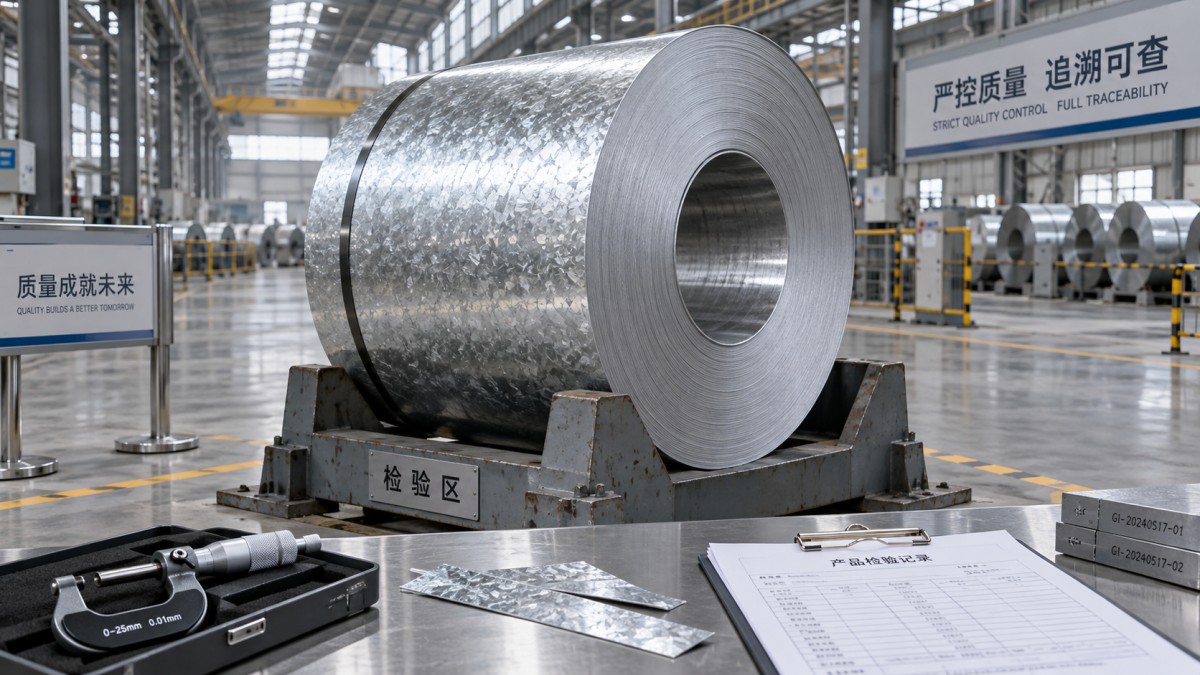
- Match identification: compare coil labels, packing lists and inspection documents. Check the producer’s coil number and any processing-related identification.
- Review test information: verify the ordered grade, dimensions and coating designation, together with relevant chemical, mechanical and coating results.
- Inspect packaging and exposed surfaces: look for water entry, edge damage, damaged bands, coating deterioration and signs of mishandling.
- Check dimensions appropriately: use calibrated equipment and the agreed measurement method. A spot measurement should not be mistaken for a complete coil assessment.
- Validate process suitability: for demanding applications, arrange agreed sampling, forming trials or additional tests before full production.
The document type should be specified before purchase. Where appropriate, buyers may request an EN 10204 inspection certificate, such as type 3.1, but its availability and scope must be agreed. A generic quality statement is not a substitute for traceable inspection information.
Inspection also has limits. Examining the outer wrap cannot establish the condition of the entire coil. For appearance-critical work, define how internal defects will be recorded, assessed and resolved when the material is uncoiled.
Distinguishing acceptable variation from a genuine quality concern
Not every visible mark makes a coil secondary. Nor should every defect be dismissed as normal. The deciding factors are the agreed specification, the severity and distribution of the condition, and its effect on the intended use.
For an exposed painted panel, surface texture or coating irregularities may become visible after finishing. For a concealed bracket, the more important issues may be bend performance, coating adhesion and dimensional consistency. The same surface condition can therefore have different commercial consequences.
Conditions worth investigating include uncoated areas, coating flaking, significant scratches exposing the substrate, persistent edge damage and severe storage corrosion. If a concern appears, retain the coil identification, photographs, affected lengths and processing records. These details support a much clearer discussion than a general complaint that the material “does not look prime.”
Agree claim procedures in advance, including notification periods, evidence requirements and arrangements for material awaiting inspection. Clear acceptance rules protect both buyer and supplier.
Choose the material around the part, not around the label
Procurement teams often buy several coil categories for the same factory. It is important to keep their functions separate. A product such as 1018 Cold Rolled Steel Coil belongs in a different material assessment: cold rolling alone does not provide the zinc protection associated with hot-dip galvanizing. It should not be treated as a direct corrosion-performance substitute.
For galvanized material, start with the finished component. Will it be deeply formed, roll-formed, welded, punched or painted? Will it remain indoors, face outdoor weathering or operate where moisture collects? These questions guide grade, coating and surface-treatment selection.
Processing can change the protection available at particular locations. Cutting exposes edges; welding can damage zinc locally and requires suitable fume controls; bending places demands on both the substrate and coating. Where necessary, specify edge protection, weld-area repair or subsequent finishing as part of the fabrication plan.
Jiangsu Zhongersheng Metal Products Co., Ltd. supplies carbon steel, galvanized steel and stainless steel materials, alongside processing services including cutting, bending, punching, welding and surface treatment. For buyers combining material sourcing with fabrication, discussing these downstream operations at the enquiry stage helps connect the coil specification with the finished-part requirements.
A clearer way to write the purchase requirement
Instead of ordering “prime galvanized coil” alone, use a specification that leaves fewer assumptions:
Prime hot-dip galvanized steel coil to [standard and grade], [nominal thickness and thickness basis] × [width], with [coating designation], [surface finish], [post-treatment], and [dimensional tolerances]. Coil inside diameter, weight limits, inspection documents, packaging and acceptance criteria as agreed.
Add application-specific requirements where needed, such as exposed-surface expectations, forming properties or painting compatibility. If material will be slit or otherwise processed before delivery, ask how identification and inspection records will remain traceable to the supplied coils.
Finally, compare offers on the same basis. Confirm whether weight is actual or theoretical, whether dimensions and coatings match, and what processing and packaging are included. A lower price is not necessarily better value if the underlying requirements differ.
The practical meaning of “prime” is straightforward: first-quality material that conforms to an agreed specification. The purchasing work lies in making that specification explicit. With the grade, coating, dimensions, surface condition and inspection requirements defined, prime hot dipped galvanized steel coils become a verifiable material choice rather than a reassuring label.
Please give us a message