


News center
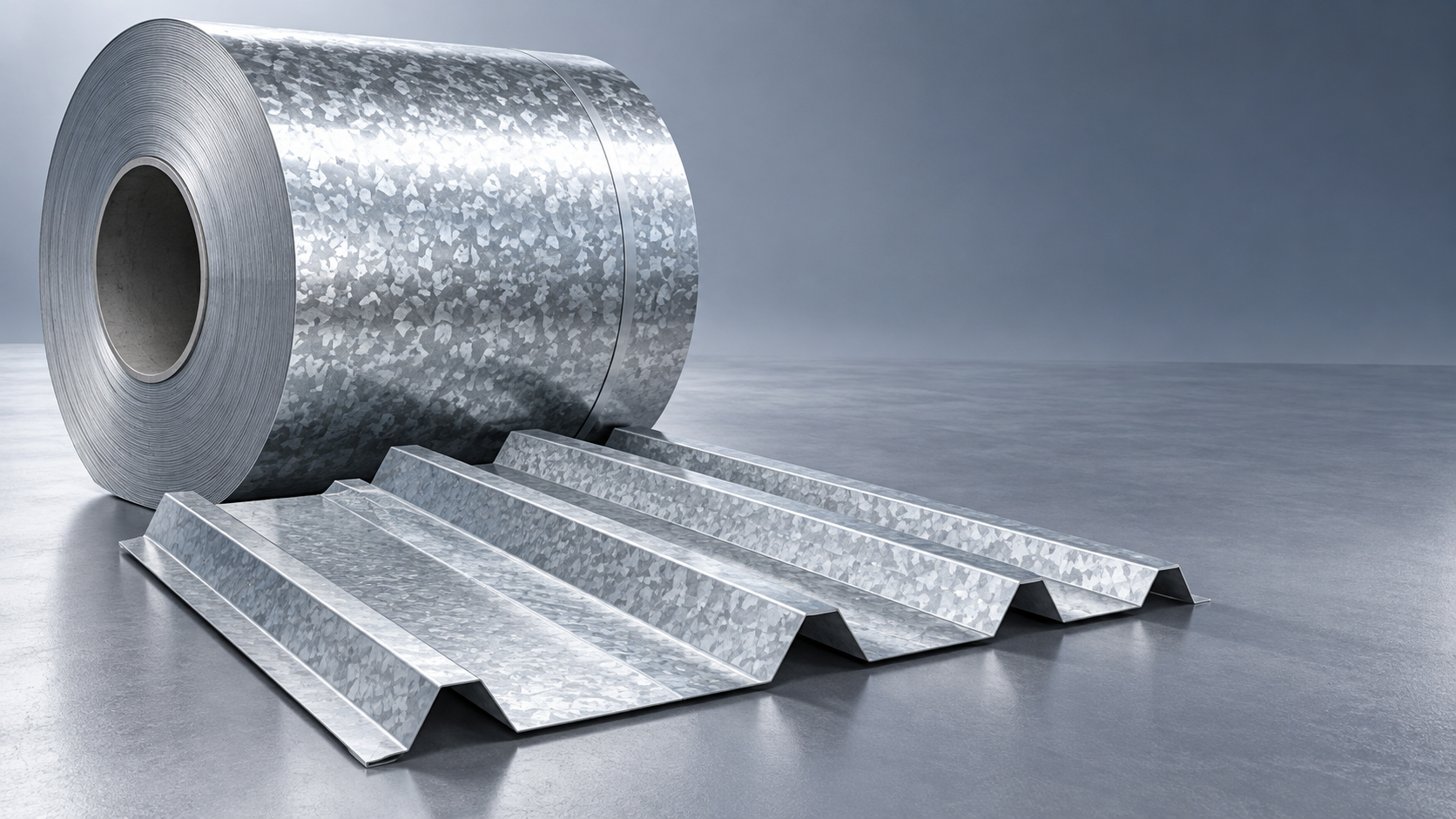
Galvanized iron coil is usually steel strip coated with zinc and supplied in a continuous roll, rather than a coil of pure iron. Roofing manufacturers form this strip into corrugated or profiled sheets. The steel provides strength and formability, while the zinc coating helps protect it against corrosion. This combination makes it a practical material for warehouse roofs, agricultural buildings, workshops, and many residential roofing systems.
When comparing roofing sheets, however, two panels with a similar silver appearance may offer different performance. A thin zinc coating, an unsuitable steel grade, or persistent exposure to salt and moisture can shorten service life. The useful question is therefore not simply whether a roof is galvanized, but whether its coating, steel thickness, profile, and installation suit the building and its surroundings.
“Galvanized iron” usually means zinc-coated steel
The term “galvanized iron,” often shortened to GI, remains common in construction and material trading. Most modern GI roofing products use low-carbon steel as the substrate. The name describes a familiar product category, but it does not fully identify the steel grade, coating quantity, or mechanical properties.
Each part of the material has a different job. The steel core carries loads and allows the strip to be shaped. The zinc layer separates that steel from the environment and provides sacrificial protection: under suitable conditions, zinc corrodes preferentially to steel, helping protect small areas exposed by scratches or cut edges.
This protection has limits. Zinc is gradually consumed, and it cannot indefinitely protect a large bare area or compensate for severe coating damage. A galvanized sheet is corrosion-resistant, not rust-proof.
Coil is the feedstock rather than the finished roof covering. After uncoiling, the material passes through forming equipment and is cut into panels. The resulting sheet may be corrugated, trapezoidal, or another engineered profile. Its performance depends on that geometry as well as on the original coil specification.
From steel strip to a roofing panel
Roofing coil is commonly produced by continuous hot-dip galvanizing. The steel strip is cleaned, processed to achieve the required properties, and passed through molten zinc. Gas wiping controls the coating quantity before the strip cools and is recoiled. Depending on the order, subsequent treatments may include surface conditioning, passivation, or oiling.
These details matter during later processing. A roofing manufacturer needs material that feeds consistently, forms without unacceptable cracking, and has a surface compatible with any planned painting or treatment. Not every galvanized coil is equally suitable for every bend radius or profile.
The familiar crystalline pattern on some galvanized surfaces is called spangle. Its size depends on production conditions and coating chemistry. Large, small, or minimized spangle can affect appearance, but spangle size alone does not establish corrosion resistance. A visually attractive surface is not a substitute for documented coating mass.
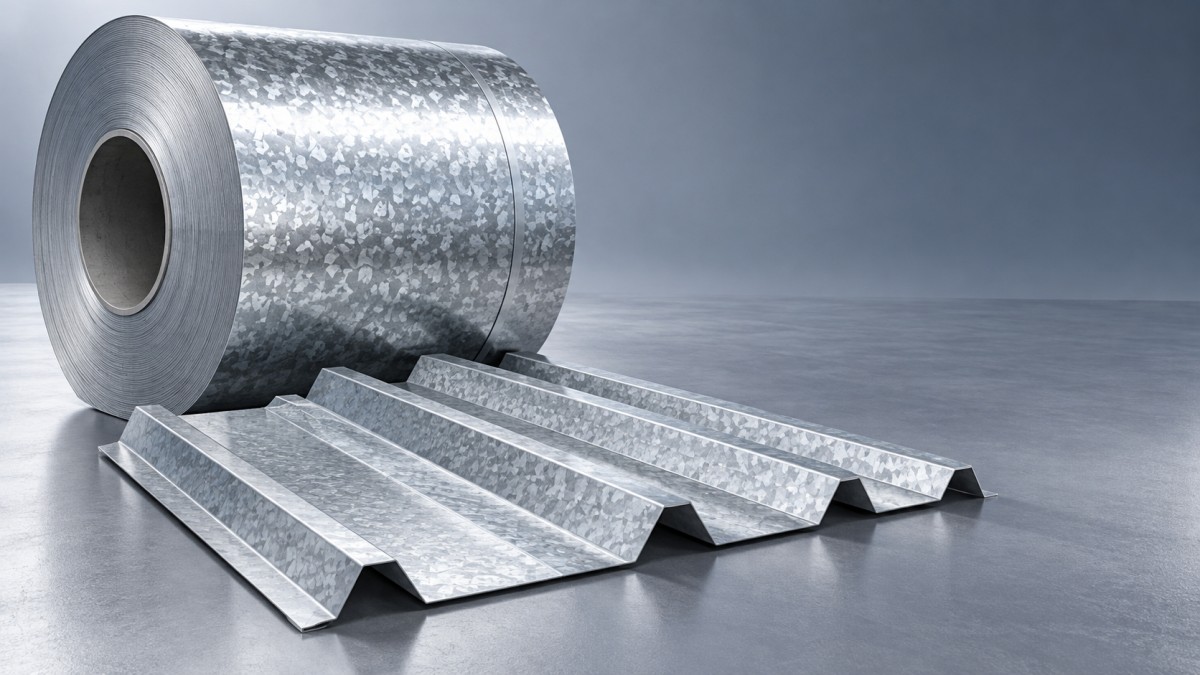
During roll forming, successive rolls gradually shape the flat strip into ribs or corrugations. These profiles increase stiffness without making the entire sheet thicker. Tight bends, unsuitable tooling, or a steel grade with insufficient ductility can damage the coating or substrate, so the coil and forming process need to be compatible.
Why roofing manufacturers use it
Corrosion protection without relying only on paint
Bare carbon steel can rust when exposed to moisture and oxygen. Galvanizing adds a protective layer across the sheet surface, including areas that may later be difficult to inspect. Zinc also develops corrosion products that can slow further attack in suitable atmospheric conditions.
For roofing, this provides protection against routine wetting and drying. It does not remove the need for drainage, appropriate fasteners, or maintenance. Standing water and trapped wet debris create much harsher local conditions than a clean, freely draining roof surface.
A workable balance of weight, stiffness, and processing cost
Profiled steel sheets can cover a building without the weight associated with some heavier roof coverings. Their relatively low weight can simplify handling and reduce roof dead load, although structural design still has to account for wind uplift, maintenance access, and other applicable loads.
Coil also supports continuous manufacturing. Producers can form repeated profiles and cut sheets to specified lengths, reducing the need to assemble a roof from many small pieces. The commercial appeal comes from the combined cost of material, processing, installation, and upkeep—not from an assumption that galvanized steel is always the cheapest option.
There are boundaries to these advantages. A metal sheet alone provides little thermal insulation, and rain noise depends strongly on the complete roof assembly. Insulation, underlays, supports, ventilation, and internal finishes determine comfort and condensation control; galvanizing does not perform those functions.
The specifications hidden behind a similar appearance
When a quotation says only “GI coil for roofing,” several important details remain unresolved. The following distinctions explain why apparently comparable offers may not be equivalent.
Coating mass and coating thickness are related, but they are not interchangeable descriptions. Coating mass is commonly expressed in grams per square metre. Under many specifications, the designation refers to the combined coating on both sides. It should not be read as the amount on each face unless the documentation explicitly says so.
Likewise, total coated thickness and base metal thickness are different measurements. Comparing one supplier’s coated thickness with another supplier’s base metal thickness can create a misleading impression of equivalence. Ask for the measurement basis before comparing offers.
A thicker steel core does not automatically mean better corrosion resistance. It may improve structural performance, but the zinc coating and exposure conditions largely govern corrosion protection. Conversely, a heavy coating does not make an under-specified panel structurally adequate.
Where the roof environment changes the answer
An inland roof that dries readily faces a different corrosion challenge from one exposed to salt spray or industrial contaminants. Coastal salts can accelerate zinc consumption, while some chemical atmospheres are unsuitable for ordinary galvanized roofing. The underside also deserves attention: condensation above a humid interior may keep the sheet wet even when the outer surface looks dry.
Agricultural buildings require particular care where animal housing, fertilizers, or chemical storage affect the atmosphere. Material selection should reflect the actual exposure, not simply the building’s description as a shed or warehouse.
For more demanding conditions, alternatives may include a suitably specified prepainted metallic-coated sheet, a different metallic coating system, or another roofing material. Prepainted steel adds a paint system over a metallic-coated substrate, but its performance still depends on coating quality, cut-edge details, and exposure. It is not automatically suitable for every aggressive environment.
Mixed-metal details can introduce another problem. Copper components, including products such as C10100/TU2 Copper Bar, are not substitutes for roofing coil. Where copper is present in nearby building details, avoid unassessed direct contact with galvanized steel and prevent copper-bearing runoff from draining onto it. Electrical contact in the presence of moisture, or deposited copper from runoff, can accelerate localized corrosion.
Installation and storage can undo a good material choice
Corrosion can begin before a sheet reaches the roof. Tightly stacked sheets exposed to rain or condensation may retain moisture between their surfaces. This can cause wet storage stain, often seen as white or gray deposits on zinc. Light staining is not the same as structural failure, but extensive attack needs assessment because some protective coating may have been consumed.
Store coils and sheets in dry, ventilated conditions, and follow the supplier’s packaging and handling instructions. Wet packs should not remain sealed or tightly stacked while moisture is trapped inside. Handling damage also matters: dragging sheets across one another can scratch surfaces before installation begins.
On the roof, small workmanship details have lasting consequences:
- Remove drilling swarf and cutting debris. Loose steel particles can rust on the surface and cause staining or localized damage.
- Use compatible fasteners and sealing washers. Their material and tightening method must suit the roof system; overtightening can damage washers or distort sheets.
- Keep laps and drainage paths correctly detailed. Poorly arranged joints can retain water or allow wind-driven rain beneath the covering.
- Use cutting methods recommended for the sheet system. Processes that create excessive heat or hot debris can damage nearby protective layers.
Galvanizing can help protect minor exposed edges, but it should not be treated as permission to ignore broad scratches, damaged bends, or exposed steel around poorly made penetrations. Repair methods should follow the roofing or coating supplier’s guidance.
Turning a material description into a useful roofing inquiry
For an initial discussion, describe the building location, exposure, intended panel profile, and whether the roof covers a dry or moisture-producing interior. Then request the steel grade, base metal thickness and tolerance, zinc coating designation, and surface treatment. This makes “galvanized iron coil” a starting description rather than the entire specification.
Structural suitability needs a separate check. Support spacing and fastening cannot be selected from coil thickness alone; they depend on the finished profile, material strength, wind loading, and the complete roof arrangement. Use applicable profile load data and project-specific structural requirements rather than borrowing details from a visually similar roof.
For an existing roof, concentrate inspections around fasteners, cut edges, overlaps, penetrations, and areas that stay damp or collect debris. These locations often reveal problems earlier than open sheet surfaces. Matching the coil specification to the exposure—and preserving that protection through forming, storage, and installation—is what turns zinc-coated steel into a dependable roof covering.
Please give us a message