


News center
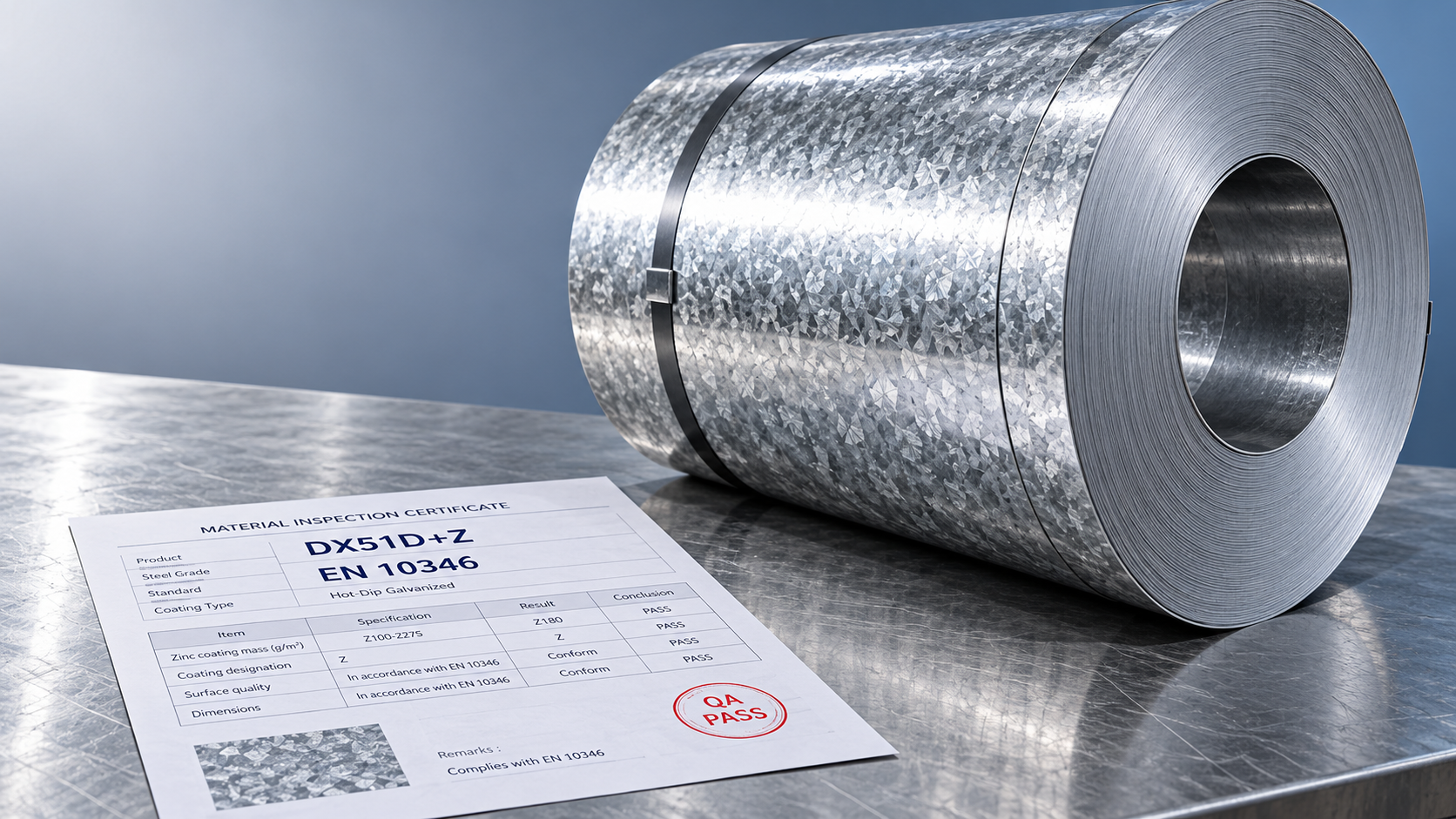
What does +Z mean on a DX51D galvanized steel coil certificate?
A DX51D+Z certificate can look straightforward, but misreading “+Z” may lead to incorrect coating acceptance decisions. For anyone inspecting a dx51d galvanized steel coil, +Z identifies a hot-dip zinc coating under EN 10346—not a specific coating mass or guaranteed corrosion service life. The steel grade, coating type and coating mass answer different questions. Keeping them separate is essential before releasing material for fabrication or installation.
The practical issue is usually not whether the coil is galvanized. It is whether the delivered coil has the coating, mechanical properties, dimensions and surface condition specified in the purchase order. A certificate showing only “DX51D+Z” does not, by itself, settle all those points.
Read DX51D+Z as two separate specifications
EN 10346 covers continuously hot-dip coated steel flat products for cold forming. Within this system, DX51D identifies a steel grade intended for bending and profiling applications. The suffix +Z identifies the zinc coating applied by the continuous hot-dip process.
These designations should not be allowed to substitute for each other. DX51D does not tell you how much zinc is present. Likewise, +Z does not establish a structural design strength, deep-drawing capability or suitability for a particular load-bearing component.
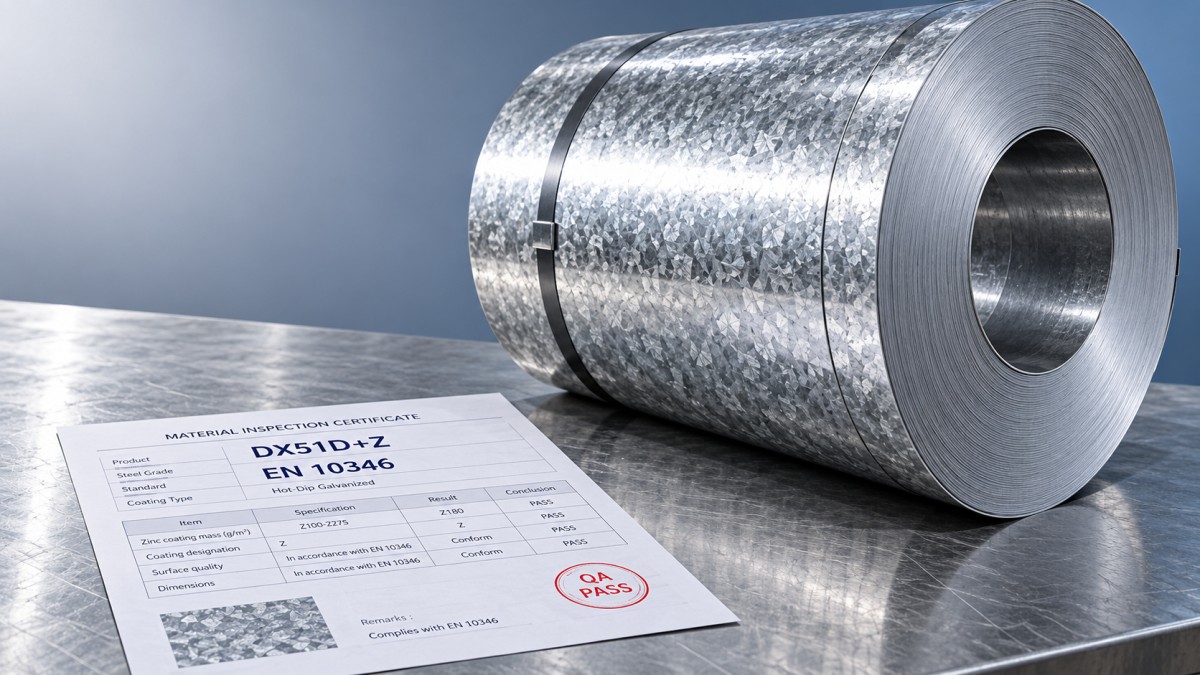
Certificate layouts vary. One document may show “DX51D+Z275” in a single field; another may list “DX51D+Z” under grade and “275” under a separate coating field. Read the complete document before treating an apparently incomplete grade line as a nonconformity.
Z275 means coating mass across both surfaces
A frequent acceptance error is interpreting Z275 as 275 g/m² on each face. Under EN 10346, the designation refers to the total coating mass on both surfaces, assessed using the specified testing rules.
For Z275, the minimum total coating mass is 275 g/m² for the triple-spot test and 235 g/m² for the single-spot test. These are different acceptance criteria, not interchangeable figures. Confirm the applicable standard edition and test provisions when reviewing an order or resolving a discrepancy.
The distinction matters when a report contains several readings. An individual result below 275 g/m² is not automatically a failure if it belongs to a compliant triple-spot test and satisfies the relevant single-spot requirement. Conversely, a satisfactory average does not excuse a result below the applicable individual minimum.
Nor does the designation guarantee an equal coating split between the two faces. If corrosion exposure, bonding or another process makes one particular face critical, that requirement needs explicit agreement rather than an assumption based on the total.
For perspective, dividing 275 g/m² equally between two faces gives a theoretical zinc thickness of approximately 19 micrometres per face, using a zinc density of about 7.14 g/cm³. This is a conversion for understanding scale—not a guaranteed local thickness or a replacement for the standard’s coating mass acceptance method.
Separate the ordered designation from the reported result
A coating designation states the specified class. A test result records what was measured or reported for the relevant inspection unit. They may appear close together on a certificate, but they serve different purposes.
For example, a “coating: Z275” entry identifies the class; it is not necessarily a measured result of exactly 275 g/m². Where inspection documentation requires actual coating results, look for the result field, units and identification linking those results to the supplied material. If a number is ambiguous, ask whether it is a nominal designation, specified minimum, average result or individual reading.
The inspection document type also matters. If the purchase order requires an EN 10204 type 3.1 inspection certificate, a general product datasheet or commercial declaration is not an equivalent substitute. Type 3.1 concerns the inspection document and its validation; it does not mean that an independent third-party inspector witnessed every test.
A handheld gauge needs the right interpretation
Magnetic coating thickness gauges can help investigate coating distribution on zinc-coated steel. However, a local thickness measurement on one face is not directly equivalent to a total two-sided coating mass test. Calibration, substrate thickness, surface roughness and measurement location can affect the reading.
Use gauge readings as controlled inspection evidence under an agreed procedure. If results are disputed, follow the applicable standard and contractual reference method rather than rejecting or accepting a coil from a few convenient surface readings.
What +Z cannot tell you about safety or service life
Zinc provides barrier protection and sacrificial protection to steel. That does not make every +Z coil equally suitable for outdoor exposure, wet interiors, coastal atmospheres or chemically aggressive environments. Coating mass is one input; moisture retention, pollutants, temperature, detailing and maintenance also influence performance.
There is no defensible way to turn “DX51D+Z” alone into a fixed number of service years. Even Z275 does not establish a universal corrosion-life guarantee. If a project specifies a design life, acceptance should connect the coating system to the actual exposure conditions and relevant project requirements.
The same caution applies to structural use. DX51D is a forming grade, not a substitute for a specified structural grade merely because both materials are galvanized. Where the design requires guaranteed yield strength or other structural properties, check the specified grade and supporting documentation. Do not infer engineering suitability from a visually sound zinc surface.
Other coating suffixes also deserve attention. +ZF identifies a zinc-iron alloy coating, while +ZM identifies a zinc-magnesium alloy coating. These are not simply alternative spellings of +Z. Substitution can affect forming, welding, painting and corrosion behaviour, so it requires technical approval rather than an informal description of “equivalent galvanized steel.”
A receiving check that catches meaningful discrepancies
The most useful receiving inspection follows the material from purchase requirement to physical coil. Checking the grade line alone leaves too many opportunities for a correct certificate to be attached to the wrong delivery.
- Match the identity. Compare coil numbers, heat or cast references where applicable, labels and packing documents. Maintain traceability when parent coils are slit or cut into sheets.
- Confirm the technical order. Check grade, coating type, coating mass designation, dimensions, tolerances, surface quality and surface treatment against the purchase order and approved amendments.
- Read the evidence. Review required test results, units and inspection document type. Establish whether the reported data relate to the delivered coil or its defined inspection unit.
- Inspect the delivery condition. Look for wet packaging, white corrosion products, damaged edges, scratches and deformation. Documentary conformity does not eliminate transport or storage damage.
- Resolve exceptions before release. Record missing data or conflicting identifiers and obtain clarification. Keep unresolved material under the site’s hold procedure rather than relying on verbal assurances.
Surface treatment deserves its own check. Oiling, passivation and other agreed treatments can affect storage performance and compatibility with painting or bonding. The suffix +Z does not establish which treatment was supplied or confirm compliance with a particular restricted-substance requirement.
Keep the certificate connected to downstream processing
An accepted coil can still become an unsuitable finished component if processing requirements are overlooked. Cutting exposes steel edges, forming can damage the coating, and welding changes local surface protection. Welding zinc-coated steel also requires an appropriate fume assessment and exposure controls; the material certificate is not a welding safety assessment.
For processed orders, clarify who retains the original coil identification, how cut pieces remain traceable and what protection or repair is required after fabrication. A parent-coil certificate establishes properties of the supplied material; it does not automatically certify the dimensions, weld quality or corrosion protection of a completed assembly.
Jiangsu Zhongersheng Metal Products Co., Ltd. supplies carbon steel, galvanized steel and stainless steel materials, alongside processing services including cutting, bending, punching, welding and surface treatment. Where supply and fabrication are combined, the useful discussion is how the original specification carries through each operation—not simply whether galvanized stock is available.
Before releasing a dx51d galvanized steel coil, confirm three separate points: the grade suits the intended application, the coating designation matches the order, and the inspection evidence is traceable to the delivery. If the certificate says only “DX51D+Z” and the specified coating mass cannot be established elsewhere in the documentation, that gap needs clarification before acceptance.
Please give us a message