


News center
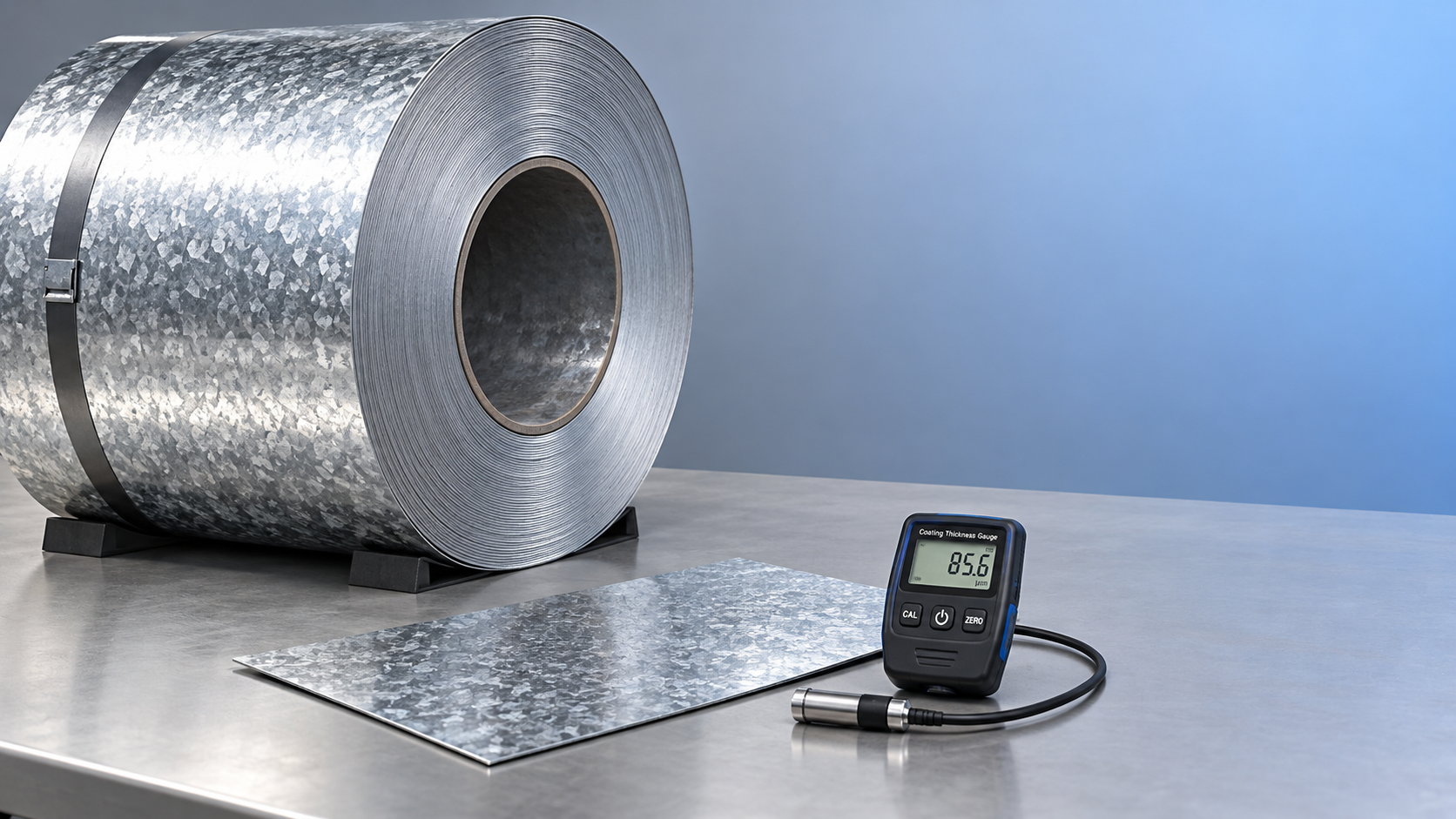
Hot-Dipped Galvanized Steel Coils: ASTM A653 vs. EN 10346 Requirements
Specifying hot dipped galvanized steel coils requires more than matching thickness and coating weight. ASTM A653/A653M and EN 10346 use different grade designations, mechanical property requirements, and coating classifications. Treating them as interchangeable can leave a fabricator with steel that looks correct on arrival but behaves differently during forming—or cannot be accepted against the project specification.
The useful comparison is not simply “American standard versus European standard.” It is whether the proposed material satisfies the same design, processing, corrosion protection, and inspection requirements. A substitution may be technically reasonable, but it needs a documented comparison rather than an equivalence statement on a quotation.
Start with the coating system, not just the standard number
ASTM A653/A653M covers steel sheet with zinc coatings and zinc-iron alloy coatings applied by the hot-dip process. EN 10346 covers continuously hot-dip coated steel flat products across several coating systems. Consequently, an order stating only “EN 10346 galvanized coil” is incomplete: the coating symbol must identify what is actually being supplied.
For the conventional zinc-coated material discussed here, the relevant EN coating symbol is +Z. Other coating systems within EN 10346 should not be treated as ordinary zinc coatings merely because they are produced on a continuous hot-dip line. Their forming, welding, surface treatment, and corrosion behavior require their own assessment.
The edition also matters. State the applicable revision in the purchase specification and identify the associated dimensional and general delivery requirements. ASTM A924/A924M provides general requirements associated with ASTM metallic-coated sheet; EN 10143 addresses dimensional and shape tolerances for continuously hot-dip coated sheet and strip. Neither should be left out of a substitution review.
Grade selection: similar strength does not mean equivalent steel
ASTM A653/A653M distinguishes commercial, forming, drawing, structural, and various higher-strength steel designations. EN 10346 likewise separates steels intended for cold forming from structural and other higher-strength grades. The designation systems, however, do not map directly onto one another.
For example, ASTM SS Grade 33 and EN S250GD+Z should not be presented as exact equivalents. Their nominal minimum yield-strength levels differ, and matching that one property would still not establish full compliance. Conversely, selecting a stronger grade is not automatically a safe upgrade: increased strength can change springback, press loads, and achievable bend geometry.
A shallow roll-formed channel and a deeply drawn housing need different assessments. The channel may be governed by structural strength and dimensional stability. The housing may be limited by ductility, surface friction, and localized thinning. For difficult forming, ask whether the grade guarantees the properties the process needs; commercial-quality terminology alone is not enough.
Elongation values also need context. Gauge length, specimen orientation, thickness, and the applicable test method affect interpretation. Two certificate values expressed as percentages are not necessarily comparable unless the test conditions are compatible.
G90 and Z275: a useful comparison with clear limits
Coating mass is where many cross-standard discussions begin. ASTM G90 specifies a minimum triple-spot average coating mass of 0.90 oz/ft², expressed as the total on both surfaces. That converts to approximately 275 g/m², which explains why G90 and EN Z275 are frequently compared.
Z275 also refers to total coating mass on both surfaces, not 275 g/m² on each side. This distinction matters when reviewing quotations or estimating zinc thickness. The designation does not, by itself, establish an equal allocation of zinc between the two faces.
The numerical similarity makes G90 and Z275 useful starting points for comparison, not interchangeable compliance labels. Check the applicable multi-spot and single-spot limits, sampling locations, test methods, and acceptance provisions in the specified editions. A coating designation is a defined acceptance requirement, not merely a nominal production target.
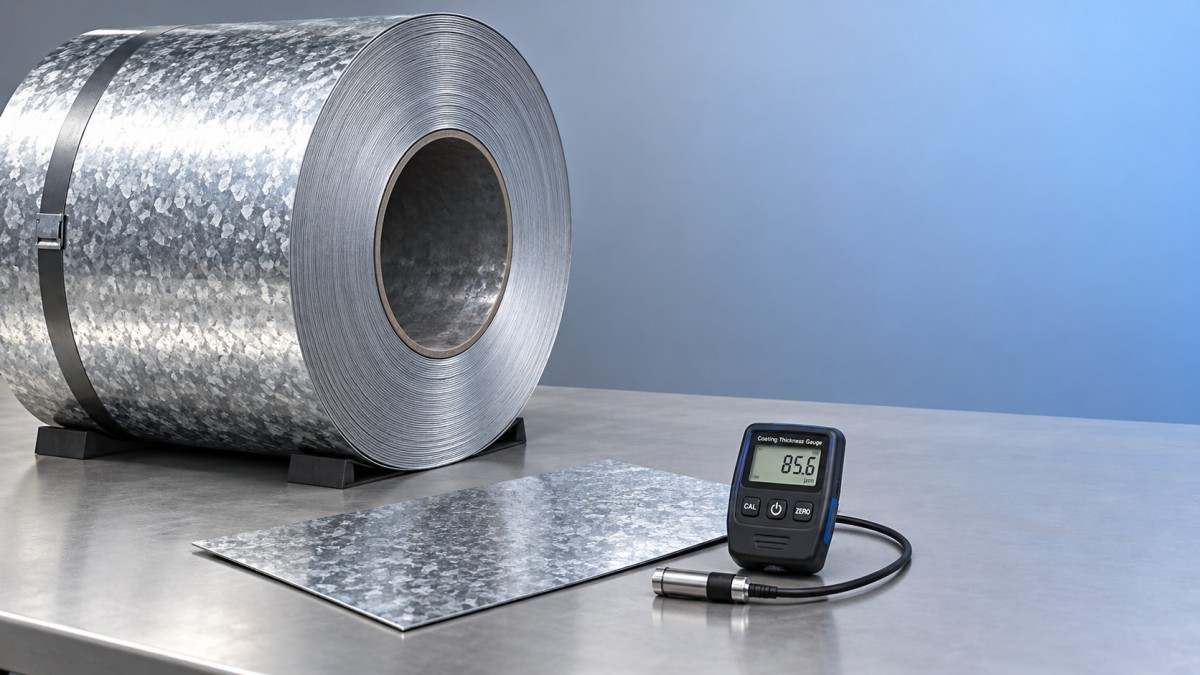
Thickness measurements require similar care. A handheld coating gauge normally measures one surface at a time, while the designation describes total coating mass across both surfaces. Converting a local thickness reading into coating mass involves assumptions and does not automatically reproduce the standard’s acceptance test.
Nor does coating mass alone establish service life. Exposure, condensation, trapped water, cut edges, and contact with other materials all matter. An indoor cable tray and an exterior component near salt exposure should not receive the same corrosion assessment simply because both use Z275.
Surface condition needs its own acceptance language
A common purchasing mistake is to expect “galvanized” to define appearance. It does not. Spangle, roughness, coating irregularities, skin-pass condition, and surface treatment can affect suitability even when coating mass and mechanical properties comply.
EN 10346 provides surface-quality designations, with availability depending on the product and coating concerned. ASTM ordering terminology and surface provisions should be reviewed separately rather than translated into an assumed EN appearance class. For exposed panels, identify the critical face and agree on acceptable appearance before production.
For painted or bonded parts, ask exactly what treatment is present: chemical passivation, oil, another treatment, or an agreed untreated condition. “Suitable for painting” is too broad unless the pretreatment and paint system are known. Where restricted-substance requirements apply, request evidence for the actual supplied treatment rather than assuming all passivation systems are identical.
Storage protection deserves attention as well. Moisture trapped between tightly wound laps can cause wet-storage staining. Agree on packaging, transport protection, and receipt inspection, while recognizing that neither packaging nor passivation makes prolonged wet storage acceptable.
Check what happens after the coil is delivered
The full specification should state thickness, width, tolerances, edge condition, coil inside diameter, and coil-mass limits. Clarify the thickness basis used for ordering and measurement, including how the metallic coating is treated under the applicable requirements. Small ambiguities can become significant when parts must fit existing tooling.
For slit strip, camber and burr condition may be more disruptive than a minor cosmetic variation. For punched and bent parts, tooling clearance, bend radius, and coating behavior deserve review. A compliant coil can still be unsuitable for a particular process window; demanding bends justify trials using representative material.
Welding adds another consideration. Zinc coatings affect welding conditions and require appropriate fume controls. Coating damage and exposed areas may need a specified repair procedure. Compliance with a sheet standard does not establish the performance of a completed welded assembly.
There are also applications where neither zinc-coated option belongs on the shortlist. For sustained high-temperature service, a heat-resistant material such as 309/309S Stainless Steel Coil may warrant a separate engineering assessment. It is not an equivalent galvanized product; temperature, atmosphere, fabrication, and design requirements must drive that decision.
Inspection documents: traceability is more useful than a generic certificate
Neither standard number is a universal third-party approval mark. Material compliance, mill inspection documentation, management-system certification, and project-specific regulatory acceptance are different matters. An ISO management-system certificate, for example, does not demonstrate that a particular coil meets the ordered grade and coating requirements.
Specify the required inspection document when ordering. If an EN 10204 type 3.1 inspection certificate is required, state that explicitly; it should not be assumed merely because EN 10346 appears on the quotation. For ASTM supply, define the required test report and any additional inspection provisions.
- Match coil identification and heat references to the delivered labels.
- Check the complete grade, coating designation, dimensions, and cited standard editions.
- Confirm which reported results cover chemistry, mechanical properties, and coating mass.
- Review test-unit coverage and sampling provisions, especially when coils are split or slit.
- Record any agreed deviations separately from a statement of full compliance.
Dual certification requires evidence against both standards. A report carrying two standard numbers is not enough if the applicable chemistry, testing, tolerances, or coating acceptance provisions have not all been addressed.
Make the supplier review specific to the finished part
When discussing hot dipped galvanized steel coils with Jiangsu Zhongersheng Metal Products Co., Ltd., connect the material specification to the processing route. The company supplies carbon steel, galvanized steel, and stainless steel products and offers processing including cutting, bending, punching, welding, and surface treatment. Those capabilities make the handover between material selection and fabrication particularly relevant.
Ask who will supply the original mill documentation, how identification will be retained after processing, and which finished dimensions or surface conditions will be inspected. If coating repair, painting preparation, or appearance approval is needed, place those requirements alongside the coil specification rather than leaving them to workshop interpretation.
Before approving an ASTM-to-EN substitution, resolve three separate questions: does the substrate suit the design and forming operation, does the coating meet the exposure and acceptance requirements, and does the documentation prove what was supplied? If any answer remains unclear, approve neither the equivalence claim nor the production release until that specific gap is closed.
Please give us a message