


News center
How long does galvanized steel g90 last in coastal environments?
Time : Oct 20, 2026
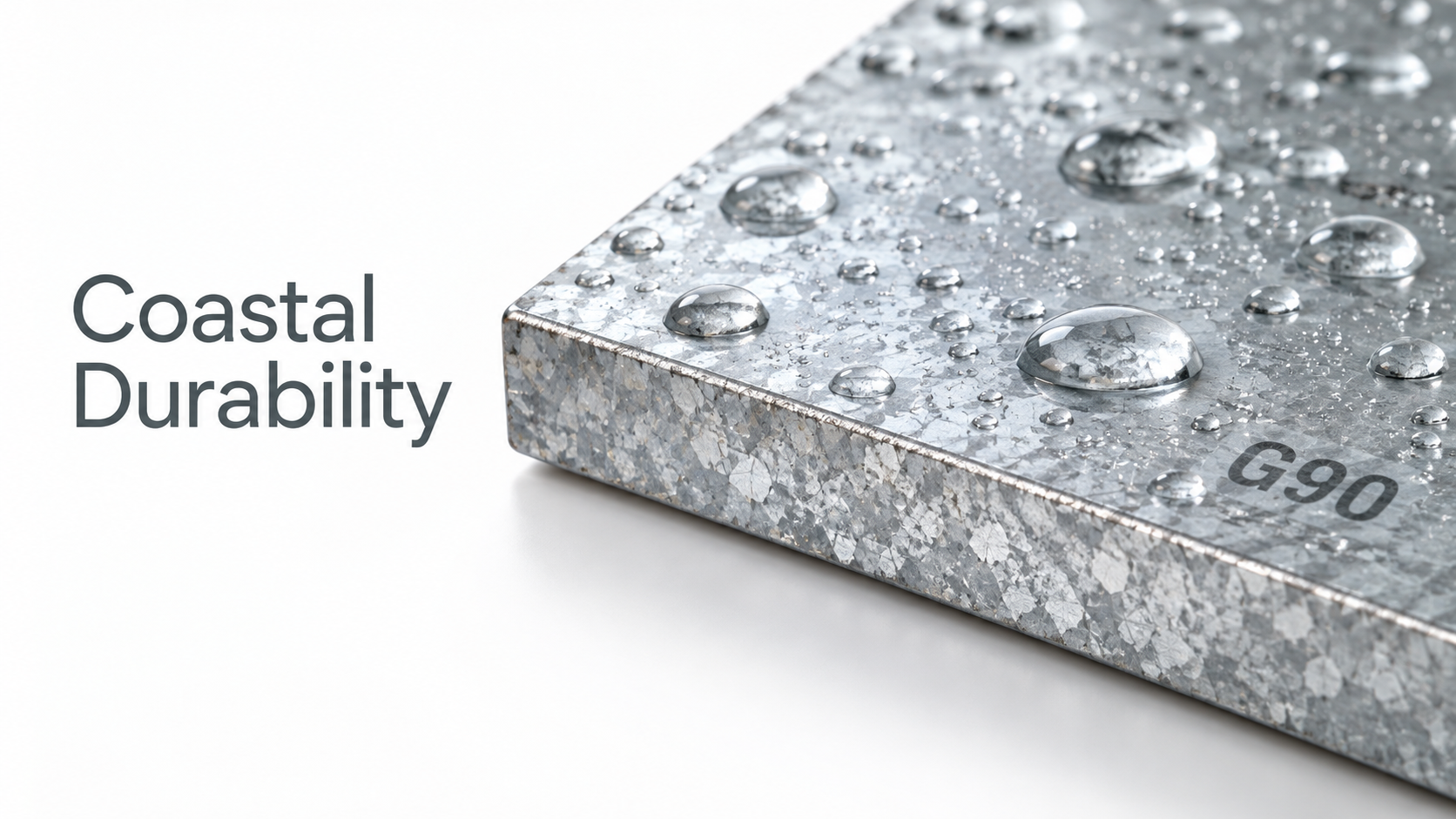
When specifying materials for coastal infrastructure, project managers frequently encounter a critical constraint: the actual service life of galvanized steel g90 in marine environments. The direct answer is that G90 galvanized steel typically lasts between 5 and 15 years in standard coastal atmospheric conditions before the zinc layer is fully consumed and significant maintenance is required. However, treating this as a fixed timeline is a fundamental engineering risk. The actual lifespan is strictly dictated by the specific corrosivity category of the micro-environment, the geometric design of the steel components, and the presence of compounded pollutants. Understanding these variables is essential for accurate lifecycle cost estimation and risk mitigation in coastal construction.
To evaluate the performance of this material, it is necessary to examine the physical limitations of the G90 coating. Under the ASTM A653 standard, G90 denotes a total zinc coating mass of 0.90 ounces per square foot, translating to approximately 275 grams per square meter (g/m²) across both sides. Consequently, the single-side zinc layer thickness is roughly 19 micrometers (μm). In highly corrosive coastal environments, classified as C4 (High) or C5 (Very High) under the ISO 12944 standard, the annual corrosion rate of zinc can range from 2.5 to over 5 micrometers per year. In severe marine industrial zones, this rate can be even higher. Mathematically, a 19-micrometer single-side layer will be consumed relatively quickly. Once the zinc is depleted, the base steel loses its cathodic protection and begins to corrode rapidly, which directly compromises structural integrity and increases long-term liability.
 The variance between a 5-year and a 15-year lifespan is not arbitrary; it is determined by specific environmental and structural variables that project managers must evaluate during the site assessment and design phases.
The distance from the shoreline and prevailing wind exposure are the primary drivers of chloride ion deposition. Structures located within 500 meters of the surf zone, particularly those facing direct sea winds, are subjected to continuous salt accumulation. In these direct splash zones or high-salt exposure areas, the corrosion rate accelerates drastically, pushing the material's lifespan toward the lower end of the estimate. Conversely, structures located several kilometers inland, where only residual marine humidity affects the site, may experience corrosion rates closer to the C3 category, extending the functional life of the G90 coating.
It is also critical to distinguish between different coastal exposure zones. A generic "coastal" classification is insufficient for engineering decisions. The atmospheric zone, where the steel is exposed to salt-laden air but remains dry most of the time, presents a very different corrosion profile than the splash zone, where the steel is continuously wetted by breaking waves and subjected to high oxygen availability. In the splash and tidal zones, the corrosion rate of unprotected or thinly coated steel is exponentially higher. G90 galvanized steel is generally not recommended for permanent structural use in the splash zone without additional heavy-duty protection.
Component geometry and water retention represent a critical, often overlooked, execution risk. Galvanized steel performs poorly in areas where moisture and salt can accumulate. Horizontal surfaces, unsealed joints, and overlapping plates create crevices that trap salt-laden water. This localized pooling prevents the zinc from drying and leads to accelerated, localized corrosion that far exceeds the flat-surface corrosion rate. Furthermore, cut edges, welding zones, and areas where the coating is damaged during transportation or installation become anodic sites. In a high-chloride environment, these exposed steel areas will corrode rapidly, and the surrounding zinc will be consumed faster as it attempts to provide cathodic protection to the exposed steel.
Coastal areas also frequently overlap with industrial or urban zones. The combination of high humidity, chlorides, and industrial sulfur dioxide (SO2) or particulate matter pushes the environment into the C5-I (Industrial) or CX (Extreme) categories. In these compound pollution conditions, the protective zinc carbonate patina cannot form properly, and the zinc layer is consumed at an exponentially higher rate. Project managers must verify local environmental data and pollution indices rather than relying on generic geographical assumptions.
For engineering leaders, relying solely on G90 galvanized steel in a coastal project without a comprehensive mitigation strategy is a high-risk approach. The decision must shift from simply selecting a baseline material to designing a targeted corrosion management plan based on the specific application.
If the project is situated in a C5 or CX environment, specifying G90 continuous galvanized sheet is technically inadequate for long-term structural components. Upgrading to higher coating classes such as G140 (approx. 42 μm total) or G180 (approx. 53 μm total) provides a thicker sacrificial layer, extending the time to first maintenance. Alternatively, for heavy structural profiles, hot-dip galvanizing should be evaluated. Hot-dip galvanizing typically yields much thicker coatings (often 50 to 100+ μm depending on steel chemistry and bath conditions), which can significantly outlast continuous galvanized coatings in severe marine conditions.
A highly effective application strategy for coastal projects is implementing a Duplex System—combining the galvanized steel substrate with a protective paint or powder coating. The zinc provides cathodic protection at cut edges, scratches, and welds, while the topcoat acts as a physical barrier against chlorides, moisture, and UV radiation. This synergy prevents the rapid consumption of the zinc layer and can extend the maintenance cycle to 20 years or more. For project managers, this approach requires coordinating with coating applicators and ensuring proper surface preparation, such as sweep blasting or the application of specialized primers, to ensure adhesion to the galvanized surface.
Design modifications are equally critical to maximizing the lifespan of any galvanized system in coastal environments. Project managers must enforce strict design protocols during the engineering phase. This includes ensuring adequate drainage and slope on horizontal surfaces to prevent water pooling, avoiding sharp corners that lead to thin coating application during manufacturing, and sealing overlapping joints with appropriate marine-grade sealants to prevent capillary action from drawing salt water into crevices. Additionally, specifying stainless steel fasteners (such as Grade 316) is mandatory when connecting galvanized components. Using carbon steel fasteners in a marine environment will lead to rapid bimetallic corrosion and localized failure of the zinc coating around the connection points.
The ultimate decision regarding galvanized steel g90 in coastal environments must be framed around lifecycle cost (LCC) rather than initial procurement price. G90 offers a lower upfront material cost compared to stainless steel, heavy hot-dip galvanizing, or duplex systems. However, if the coastal environment dictates a 7-year maintenance cycle, the cumulative cost of scaffolding, surface preparation, downtime, and recoating over a 20-year project lifespan will far exceed the initial material savings.
Project managers must calculate the Net Present Value (NPV) of these future maintenance interventions. If the site is classified as C5 or CX, the procurement strategy should immediately pivot to duplex systems, higher-grade alloys, or thicker hot-dip coatings. G90 should only be considered viable in coastal projects for temporary structures, inland buffer zones where marine exposure is minimal, or non-critical components where frequent, low-cost replacement is economically and operationally feasible. By aligning the material specification with the actual corrosivity of the micro-environment and the structural design, engineering leaders can ensure long-term durability and avoid costly premature failures.
Next:No more content
Please give us a message
Jiangsu Zhongersheng Metal Products Co., Ltd.
Phone : +86 18015371666
WhatsApp : +86 15961738947
WeChat : +86 18015371666