


News center
How does the matte surface of galvannealed coil improve paint adhesion?
Time : Oct 19, 2026
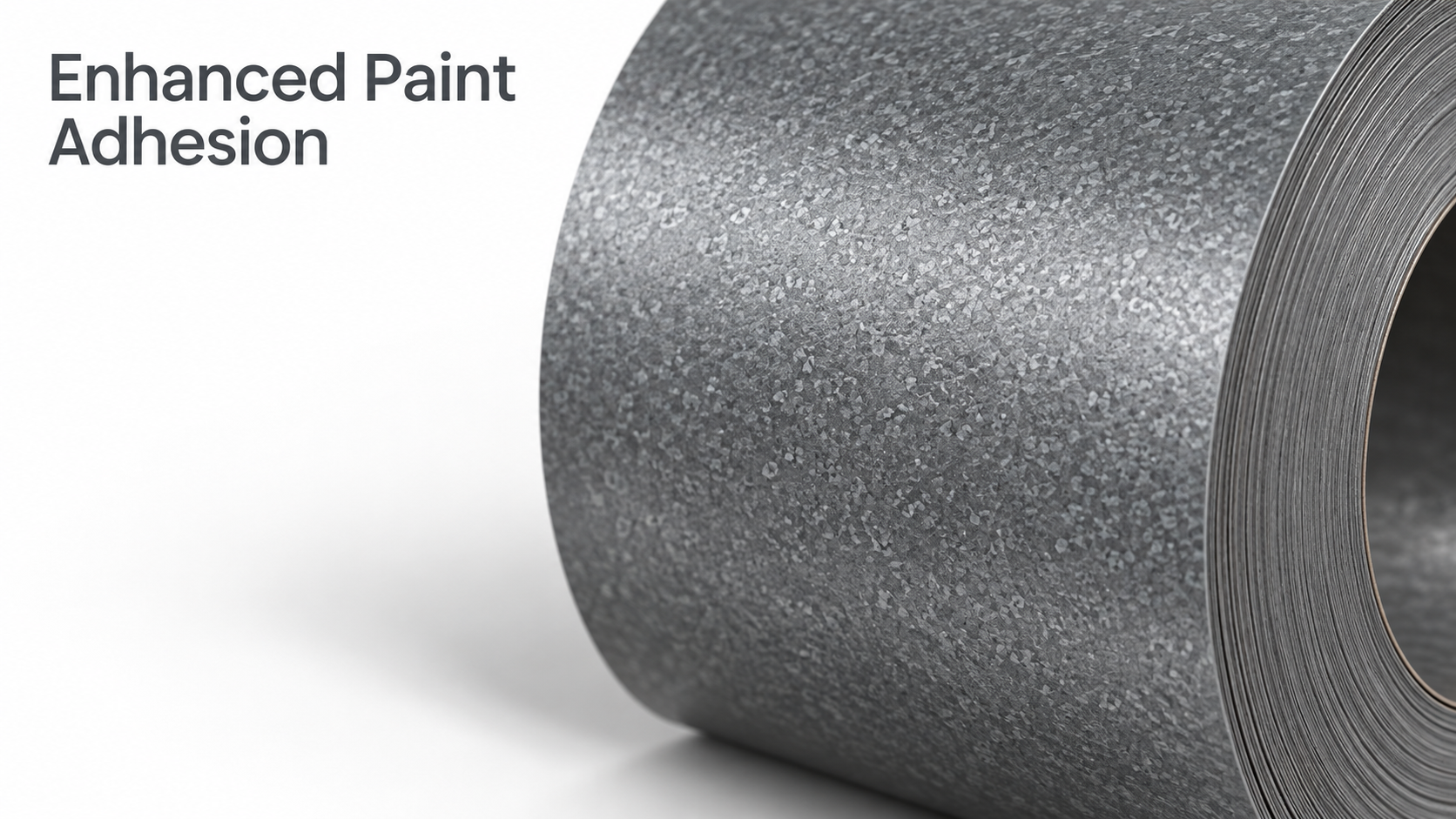
For technical evaluators seeking optimal coating performance, understanding the specific surface characteristics of a galvannealed coil is crucial. The unique matte finish, resulting from a specialized diffusion heat treatment process, provides an ideal micro-texture that significantly enhances paint adhesion and overall corrosion resistance. The transition from a shiny, spangled pure zinc coating to a dull, matte zinc-iron alloy surface is not merely a cosmetic change; it represents a fundamental shift in both surface topography and chemical composition. This metallurgical transformation directly dictates how liquid coatings interact with the steel substrate, ultimately determining the durability and mechanical stability of the finished painted product.

The Metallurgical Origin of the Matte Surface
To understand how the matte surface improves paint adhesion, it is necessary to examine the galvannealing process itself. After the steel strip undergoes continuous hot-dip galvanizing, it is immediately passed through an inline heating furnace where the temperature is raised to between 500°C and 560°C. This thermal treatment initiates a solid-state diffusion process. Zinc from the coating diffuses into the steel substrate, while iron from the substrate diffuses outward into the zinc layer. This interdiffusion transforms the outer layer of the coating from nearly pure zinc into a series of zinc-iron alloy phases, predominantly the Gamma phase (Fe3Zn10) and the Delta phase (FeZn7). The formation of these alloy phases completely eliminates the visible zinc crystals, known as spangles, which are characteristic of standard galvanized (GI) coatings. The resulting surface is uniformly dull, non-reflective, and matte. More importantly, this phase transformation fundamentally alters the physical and chemical landscape of the coating, creating a surface that is inherently more receptive to organic paint systems.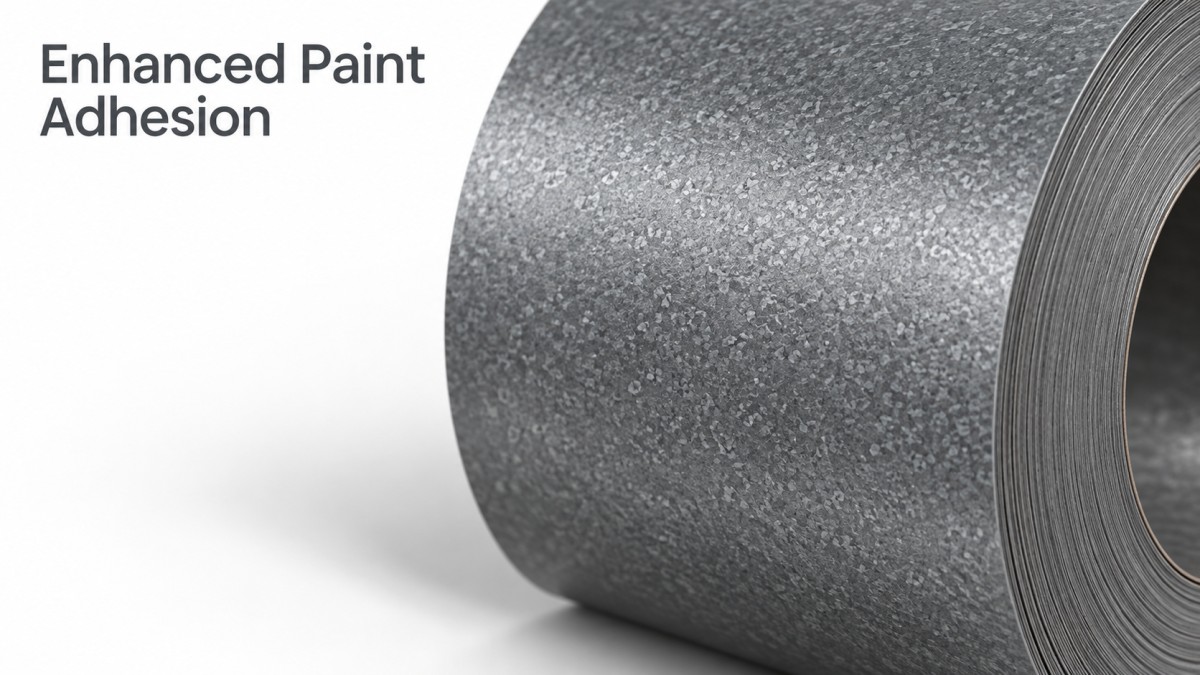
Mechanical Interlocking Through Micro-Topography
The most immediate benefit of the matte surface is the enhancement of mechanical interlocking. Paint adhesion relies heavily on the physical anchoring of the cured coating into the microscopic peaks and valleys of the substrate. Standard pure zinc coatings, particularly those that are skin-passed or temper-rolled to achieve a uniform finish, often present a relatively smooth surface profile. While this smoothness is beneficial for certain forming operations, it limits the number of physical anchor points available for paint. The alloying process in galvannealed production naturally generates a complex, nodular micro-texture. As the zinc-iron alloy crystals nucleate and grow during the diffusion phase, they create a highly irregular surface profile. This matte texture significantly increases the specific surface area of the steel. When liquid paint or primer is applied, it flows into these micro-crevices and pores. Upon curing, the coating is mechanically locked into the substrate. For technical evaluators, surface roughness is typically quantified using parameters such as Ra (Arithmetic Average Roughness) and Pc (Peak Count). While Ra measures the average deviation of the surface profile, Pc measures the number of peaks within a specified sampling length. The matte surface of a galvannealed coil typically exhibits a much higher Pc compared to standard GI. A higher peak count means there are more microscopic anchor points per unit area, which drastically increases the mechanical resistance against coating delamination under stress, impact, or thermal cycling.Surface Energy and Chemical Bonding Dynamics
Beyond mechanical anchoring, the matte surface of a galvannealed coil provides superior chemical compatibility with paint systems due to changes in surface energy. The outer layer of a standard galvanized coating is almost entirely pure zinc. Pure zinc has a relatively low surface energy and forms a passive oxide layer when exposed to the atmosphere, which can act as a weak boundary layer for organic coatings. In contrast, the zinc-iron alloy layer that creates the matte finish has a distinctly different chemical composition. The presence of iron at the surface alters the electronegativity and increases the overall surface energy of the substrate. Higher surface energy directly improves the wettability of the surface. When a liquid coating is applied to a high-energy surface, it spreads more readily and uniformly, minimizing defects such as crawling, cratering, or poor edge coverage. Furthermore, the iron-rich surface of the alloy layer is more chemically active than pure zinc. This increased reactivity allows for stronger secondary chemical interactions between the substrate and the functional groups present in the paint resins. In systems utilizing epoxy primers or electrodeposition coatings (E-coat), the zinc-iron surface can participate in hydrogen bonding and van der Waals forces more effectively than a passive pure zinc surface. This chemical affinity ensures that the initial boundary layer of the paint adheres tightly to the steel, preventing moisture ingress and subsequent underfilm corrosion.Elimination of Spangle Boundaries and Coating Uniformity
A critical, often overlooked advantage of the matte, non-spangled surface is the elimination of spangle boundaries. In standard galvanized steel, the edges where individual zinc crystals meet are areas of micro-segregation and topographical valleys. These boundaries are chemically and physically distinct from the center of the spangles. When paint is applied over a spangled surface, the liquid tends to pool in the valleys at the spangle boundaries. This results in an uneven film thickness, with thicker paint in the valleys and thinner paint over the crystal centers. Uneven film thickness leads to differential curing rates and internal stresses within the coating. Over time, these stresses concentrate at the spangle boundaries, making them the primary initiation sites for coating failure, blistering, and loss of adhesion. The matte surface of a galvannealed coil provides a chemically and topographically uniform canvas. Without the distinct crystalline boundaries, the paint film cures uniformly across the entire surface. This uniformity eliminates the localized stress concentrations inherent in spangled coatings, resulting in a more cohesive and durable paint system that maintains its adhesion integrity over a longer service life.Technical Evaluation Parameters and Application Limitations
While the matte surface of a galvannealed coil offers undeniable advantages for paint adhesion, technical evaluators must carefully balance these benefits against the material's formability and the specific requirements of the manufacturing process. The very mechanisms that enhance adhesion can introduce challenges if the alloying process is not strictly controlled. The primary variable to monitor is the iron content within the alloy layer. Optimal paint adhesion and formability are typically achieved when the iron content is maintained between 9% and 12% by weight. If the galvannealing process is allowed to proceed too far, the iron content will exceed this optimal range, and the coating will become excessively brittle. A brittle, heavily alloyed matte surface is highly susceptible to powdering and flaking during stamping or roll-forming operations. Powdering occurs when the alloy layer fractures into a fine dust under mechanical stress, while flaking involves larger pieces of the coating peeling away. If powdering occurs, the micro-texture that was intended to provide mechanical interlocking is destroyed, and the fine zinc-iron dust acts as a release agent, completely neutralizing the paint adhesion. Therefore, evaluating a galvannealed coil requires verifying that the supplier maintains tight control over the inline heating temperature and dwell time to prevent over-alloying. Additionally, the specific surface roughness profile must be matched to the intended paint system. While a high peak count (Pc) is generally beneficial for mechanical interlocking, an excessively rough matte surface can cause issues with very thin coating applications, such as certain E-coat systems, where the coating may not fully bridge the peaks, leaving microscopic voids that compromise corrosion resistance. Evaluators should request surface profile data (Ra, Rz, Pc) from the material supplier and correlate it with the specific primer and topcoat thickness specified for the final product.Assessing Adhesion in the Context of the Complete System
When conducting technical evaluations, it is important to recognize that the matte surface of a galvannealed coil primarily enhances the adhesion of the primer or the initial E-coat layer, rather than the final topcoat. The overall durability of the painted product relies on the intercoat adhesion between the primer and the topcoat, as well as the intrinsic properties of the topcoat itself. Standard adhesion tests, such as the cross-cut test (ASTM D3359), are useful for initial quality control, but they do not fully simulate long-term environmental exposure. Technical evaluators should prioritize cyclic corrosion testing (such as ASTM G85 or ISO 11997) and humidity resistance testing. The true value of the matte zinc-iron surface is revealed in its ability to prevent the lateral creep of corrosion from scribe marks or edges. The combination of mechanical interlocking, enhanced chemical bonding, and uniform film thickness ensures that even if the topcoat is breached, the primer remains tightly adhered to the substrate, effectively blocking the progression of underfilm corrosion. Ultimately, the matte surface of a galvannealed coil is not a passive finish; it is an engineered micro-structure designed to optimize the interface between inorganic steel and organic coatings. By understanding the metallurgical phase transformations, the resulting topographical changes, and the surface energy dynamics, technical evaluators can make informed decisions regarding material selection, ensuring that the chosen steel substrate will reliably support the required coating performance throughout the product's lifecycle.Next:No more content
Please give us a message
Jiangsu Zhongersheng Metal Products Co., Ltd.
Phone : +86 18015371666
WhatsApp : +86 15961738947
WeChat : +86 18015371666