


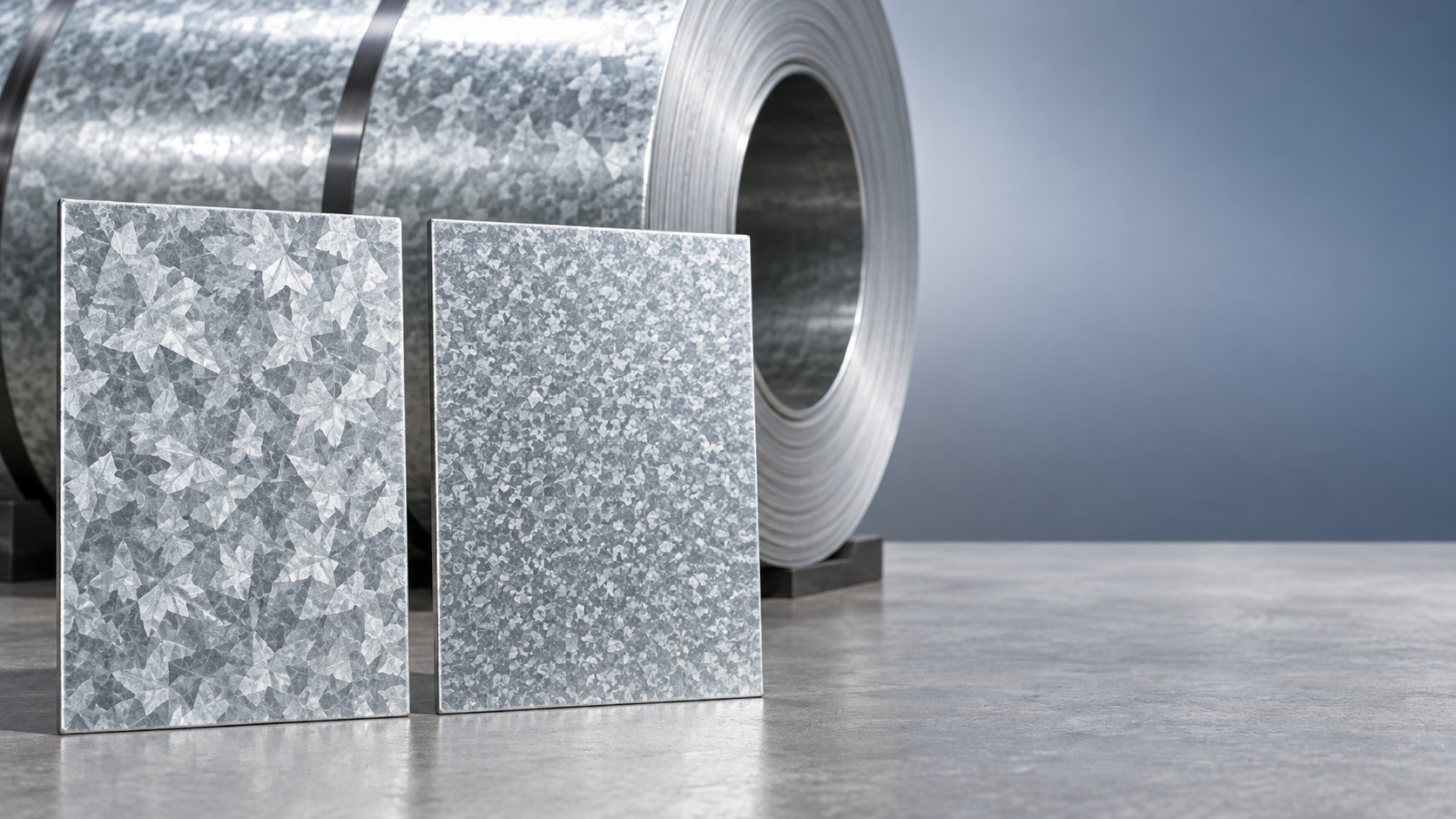
No. Regular spangle galvanized steel coil does not inherently resist corrosion better than minimized spangle material. Visible zinc crystals describe surface appearance, not a durability rating.
For technical evaluators, the decisive factors are zinc coating mass, coating continuity, surface treatment, fabrication damage, and the actual conditions surrounding the finished component.
A visible zinc crystal pattern can accompany reliable protection, but it cannot establish coating thickness, predict service life, or replace documented inspection and testing.
The practical question is whether a particular coil provides sufficient, verifiable protection for its application. That requires comparing specifications and evidence under equivalent conditions.
This article explains what spangle reveals, which purchasing criteria matter most, and how to assess supplier data without treating an attractive surface as proof of performance.
What Does the Visible Spangle Actually Tell You?
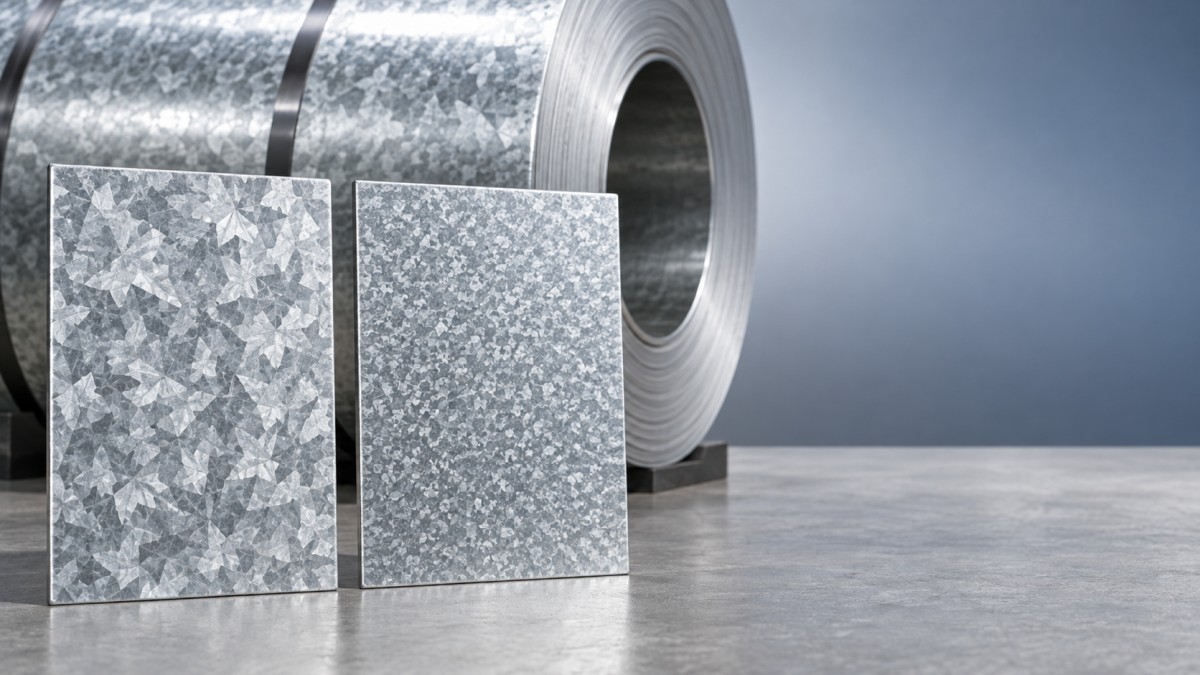
Spangle is the crystalline pattern formed as the zinc coating solidifies after continuous hot-dip galvanizing. Its appearance reflects solidification conditions and coating bath chemistry.
Regular spangle generally presents a readily visible pattern. Minimized spangle presents smaller, less conspicuous crystals, while other controlled finishes can appear substantially more uniform.
These descriptions classify appearance rather than corrosion performance. A visually prominent pattern does not demonstrate that more zinc has been deposited on the steel.
Crystal size alone also cannot confirm whether the coating is continuous, properly bonded, or adequately protected against deterioration during transport, storage, and subsequent processing.
For example, regular spangle and minimized spangle coils with equivalent coating mass and treatment may provide comparable protection when exposed under similar service conditions.
Differences in performance require investigation of the complete coating system. Rejecting or approving material solely because of spangle size can therefore produce an incorrect technical decision.
Which Coating Properties Actually Control Corrosion Resistance?
Zinc protects steel through a physical barrier and sacrificial action. It corrodes preferentially, helping protect exposed steel at sufficiently small scratches and cut edges.
Coating mass determines the available zinc reserve. Other conditions being equal, a heavier coating generally takes longer to consume before the underlying steel becomes vulnerable.
However, heavier coating does not correct every weakness. Bare areas, poor adhesion, severe processing damage, and unsuitable exposure conditions can still cause premature localized failure.
Coating distribution also matters. A stated total coating mass may conceal differences between surfaces, so evaluators should understand requirements for each side where exposure differs.
For illustration, Z275 denotes a nominal coating mass of 275 grams per square metre, expressed as the combined amount on both surfaces under the applicable standard.
Assuming equal distribution and a zinc density near 7.14 grams per cubic centimetre, that corresponds to approximately 19 micrometres of zinc per surface.
This calculation is illustrative, not an acceptance rule. The governing standard defines sampling, minimum values, and tolerances; actual compliance must be assessed using those requirements.
Do not confuse coating thickness with steel thickness. A thicker steel substrate improves structural capacity where appropriately designed, but does not automatically increase the zinc reserve.
How Should Regular Spangle Compare With Other Finishes?
A useful comparison holds coating designation, substrate grade, surface treatment, and exposure constant. Otherwise, the evaluation may wrongly attribute a coating difference to spangle appearance.
Regular spangle is often selected when its visible pattern is acceptable. Minimized spangle may suit applications requiring a more uniform appearance or specific finishing characteristics.
Painting suitability requires separate confirmation. Surface cleanliness, chemical treatment, roughness, and paint compatibility can influence adhesion more directly than the presence of visible crystals.
When these performance variables match, choosing between finishes becomes primarily an application and appearance decision. Any claimed durability advantage should be supported by relevant comparative evidence.
Also distinguish minimized spangle galvanized steel from galvannealed steel. Galvannealed material has a zinc-iron alloy coating and requires its own forming, painting, and corrosion assessment.
Will the Service Environment Overwhelm the Coating?
Environmental exposure can outweigh modest differences between coating specifications. Time of wetness, chloride deposition, pollutants, temperature, and surface geometry all influence the rate of zinc consumption.
In sheltered, dry interior service, galvanized material may face relatively low corrosion demand. Condensation or hidden moisture traps can nevertheless create aggressive local conditions.
Coastal locations require closer evaluation because salt deposits attract moisture and increase electrolyte conductivity. Distance from the shoreline alone cannot fully describe the exposure.
Industrial sites can introduce acidic contaminants or other chemicals that accelerate zinc loss. Identify actual substances and concentrations before assuming standard galvanized material is suitable.
Persistent immersion, strongly acidic or alkaline contact, and poorly drained assemblies require specific assessment. Atmospheric corrosion experience should not be transferred directly to these conditions.
Detailing matters as well: horizontal ledges, overlapping joints, and unventilated cavities can retain moisture, creating conditions substantially more severe than the surrounding atmosphere suggests.
For demanding exposure, consider a heavier zinc coating, a compatible paint system over galvanizing, improved drainage, or another material selected for the actual failure mechanism.
Which Supplier Documents and Tests Deserve Your Attention?
Begin with the governing product standard and its current agreed edition. Common references include ASTM A653/A653M and EN 10346, depending on project and market requirements.
Specify substrate grade, dimensions, coating designation, finish, treatment, and required inspection documentation. A purchase description stating only “regular spangle” leaves essential performance requirements unresolved.
ASTM G90 and EN Z275 represent broadly similar total coating mass levels, but designation similarity does not make all acceptance requirements or products automatically interchangeable.
Request traceable inspection documents identifying the supplied coil and reporting the agreed properties. Confirm that reported results represent the delivered material rather than an unrelated sample.
Coating mass measurements should follow the agreed standard. Magnetic thickness measurements can support inspection, but roughness, calibration, probe positioning, and measurement location affect their interpretation.
Salt spray testing can help compare specified systems under controlled conditions. It should not be converted directly into years of outdoor service through a universal multiplier.
Evaluate the protocol, specimen preparation, edge protection, exposure duration, and failure criterion. White corrosion products and red rust indicate different stages and should be reported separately.
For consequential projects, relevant field history or representative exposure testing can strengthen the assessment. Evidence is most useful when its environment resembles the intended application.
Can Storage and Fabrication Undo a Good Coating Specification?
A compliant coil can deteriorate before installation if moisture enters tightly packed surfaces. Restricted airflow can promote wet storage stain, commonly seen as white corrosion products.
These deposits do not automatically establish complete coating failure. Their severity, remaining zinc thickness, appearance requirements, and intended service should guide inspection and disposition.
Store coils under suitable cover, prevent water ingress, and manage condensation during temperature changes. Follow supplier handling guidance, particularly when packaging becomes wet in transit.
Forming introduces another variable. Tight bends, unsuitable tooling, or an incompatible substrate grade may damage the coating or steel even when the incoming coil meets specification.
Assess forming suitability using the intended bend geometry and processing conditions. Review coating adhesion and surface condition after representative operations where the application warrants verification.
Cut edges and punched holes expose steel. Zinc can provide local sacrificial protection, but its effectiveness depends on exposure severity, geometry, and available surrounding coating.
Welding removes or damages protection locally and requires appropriate process controls. Specify an accepted repair procedure where required, and inspect repaired areas before final assembly.
What Should Go Into a Technically Useful Purchase Specification?
Translate the durability objective into measurable requirements before requesting quotations. This allows suppliers to price equivalent material and reduces disputes caused by incomplete product descriptions.
Define the service environment, intended design life, and maintenance assumptions. Where exact life prediction is uncertain, state the exposure basis and acceptable inspection criteria explicitly.
Next, specify the steel grade, thickness, dimensional tolerances, coating designation, and any required coating distribution. Keep the appearance requirement distinct from the corrosion protection requirement.
Identify the required surface treatment and downstream operations. Oiling, passivation, painting, bonding, and welding must be considered together because treatment choices can affect subsequent processing.
Include document traceability, agreed sampling methods, defect acceptance limits, packaging, and handling requirements. For critical applications, define how nonconforming material will be evaluated and resolved.
A useful supplier comparison therefore asks which quotation meets the complete specification. A lower price has limited meaning when coating mass or treatment remains undefined.
When Should You Consider a Different Material?
Regular spangle galvanized steel coil remains a practical option for many construction, fabrication, and equipment applications when its coating and exposure requirements are properly matched.
Some applications demand a different material strategy. Sustained elevated temperatures, aggressive chemicals, or unusually severe exposure can require solutions beyond a conventional zinc coating.
For elevated-temperature service, 309/309S Stainless Steel Coil may merit evaluation because these grades are commonly considered for oxidation resistance at elevated temperatures.
That does not establish suitability for every corrosive environment. Grade selection must still consider temperature, chemical exposure, fabrication, and the dominant damage mechanism in service.
Jiangsu Zhongersheng Metal Products Co., Ltd. supplies galvanized, carbon, and stainless steel products, alongside processing services including cutting, bending, punching, welding, and surface treatment.
For a meaningful procurement discussion, provide the exposure conditions, drawings, processing sequence, and acceptance criteria. These details help connect material selection with actual component requirements.
Final Assessment: Buy Verified Protection, Not a Crystal Pattern
Regular spangle does not inherently provide superior corrosion resistance. Its visible pattern identifies an appearance characteristic; durability depends on the coating system and service conditions.
Prioritize verified zinc coating mass, continuity, suitable treatment, fabrication quality, and environmental compatibility. Compare finishes only after these variables have been brought onto an equivalent basis.
Approve a coil when documented properties meet the project specification and anticipated exposure. That provides a defensible technical decision and a clearer basis for supplier accountability.