


News center
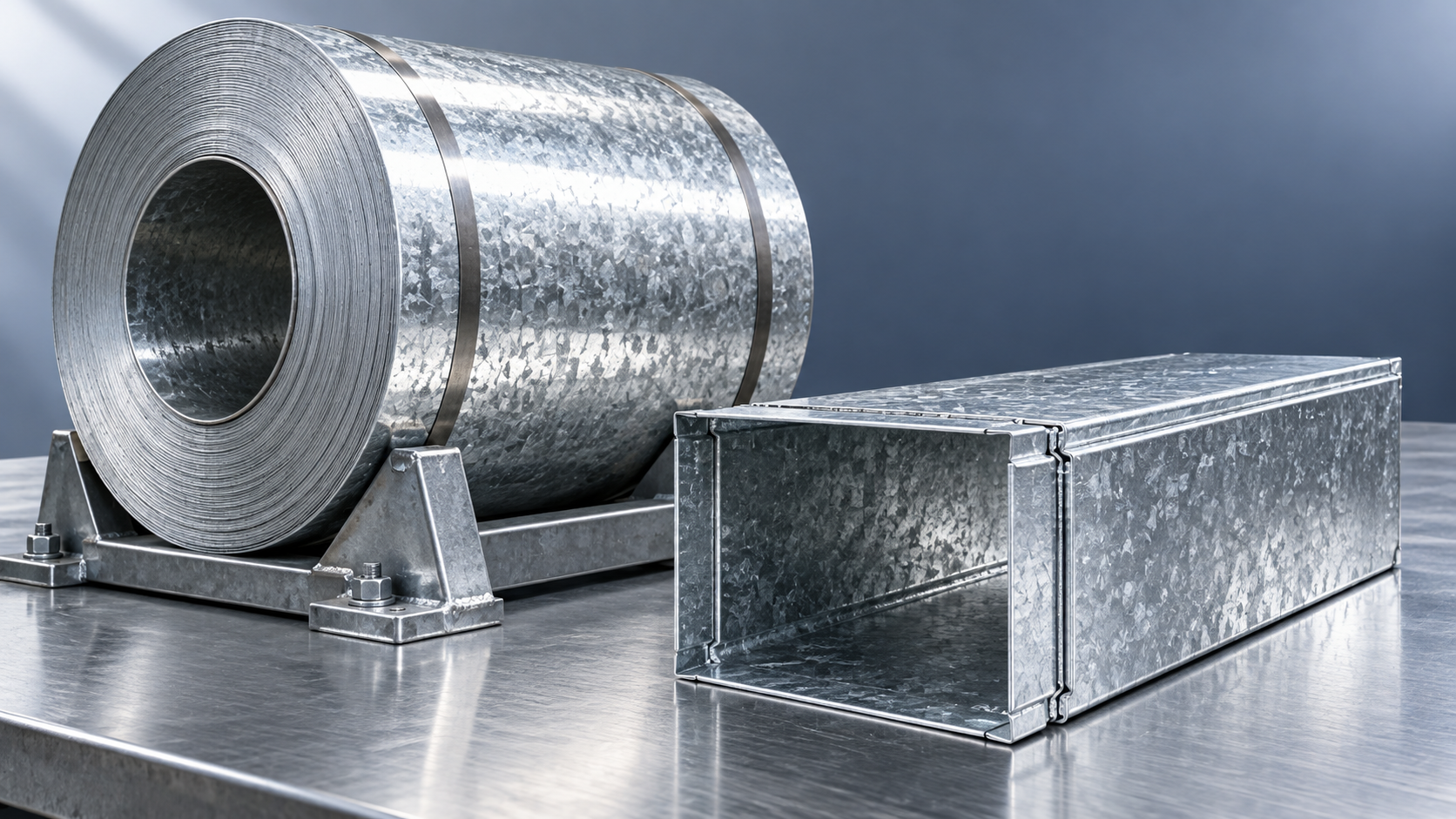
Specifying galvanized steel sheet in coil for HVAC duct fabrication starts with three decisions: what exposure the duct will face, what construction the duct design requires, and what the fabrication equipment can process consistently. A purchase order that states only “galvanized coil” and a nominal gauge leaves too much open to interpretation.
The material specification should connect the duct design to measurable purchasing requirements: steel grade, thickness and tolerances, zinc coating designation, surface treatment, coil dimensions, and inspection documents. Defining these together helps prevent material that looks acceptable on delivery from causing cracked seams, feeding problems, or avoidable corrosion after installation.
Start with the duct’s service conditions
Ordinary indoor ventilation ductwork and an outdoor exhaust system do not necessarily need the same material. Establish whether the duct carries conditioned air, humid air, contaminated exhaust, or air containing corrosive substances. Also consider the environment around the duct: a dry ceiling void presents different exposure from a coastal rooftop or a regularly washed production area.
Galvanizing protects steel through a zinc coating that provides a barrier and sacrificial protection. That protection has limits. Persistent moisture, aggressive chemicals, and deposits that retain water can consume the coating faster than normal dry indoor exposure. Increasing zinc coating mass may improve durability under suitable conditions, but it does not automatically make galvanized steel appropriate for chemically aggressive exhaust.
Condensation deserves particular attention. Cold supply ducts passing through warm, humid spaces can collect moisture when insulation or vapor control is inadequate. More zinc cannot correct a poorly detailed insulation system. Material selection, insulation, drainage, and weather protection need to work together.
Identify special systems early. Grease exhaust, smoke control, and fire-rated duct assemblies can have construction and approval requirements that determine the material choice. A general ventilation coil specification should not be carried into these systems without checking the governing design requirements.
Specify thickness from the duct construction requirements
Sheet thickness should follow the approved duct construction schedule. Duct size, shape, pressure, reinforcement, joint arrangement, and support spacing all affect the required construction. Air velocity alone is not enough to select thickness, and purchasing heavier material does not automatically solve an inadequate reinforcement layout.
A common procurement mistake is using gauge as the only thickness description. Gauge conventions differ between markets and material systems. State thickness in a defined unit and identify whether it refers to the base steel or the coated product. The coating contributes to measured overall thickness, so these terms are not interchangeable.
Also distinguish nominal thickness from minimum permitted thickness. A nominal value normally operates within an agreed tolerance; it does not mean every measured point must equal that value. If the duct design depends on a minimum base-metal thickness, the purchase specification and inspection method must reflect it.
The practical balance is to avoid both insufficient thickness and unnecessary material. Under-thickness sheet can compromise stiffness and joint performance. Excess thickness increases weight and may exceed the comfortable forming range of seamers, folders, or flange equipment. Approve substitutions against both the duct design and the fabrication process.
Choose a steel grade that suits the seams and bends
Galvanized sheet grades differ in mechanical properties and forming capability. For duct fabrication, the steel must tolerate the intended lock seams, flanges, bends, and shaping operations while maintaining sufficient stiffness. A broad description such as “commercial quality” may be too ambiguous when purchasing across different supply markets.
Name the applicable sheet product standard and the grade or quality designation within it. Then connect that choice to the actual forming work. Straight rectangular ducts, tight folded seams, and formed fittings can place different demands on the material. Higher strength is not automatically beneficial: it can increase springback and forming loads.
Where the material source or grade changes, run a representative fabrication trial before releasing the full order. Use the intended tooling and include demanding operations such as seam closure and tight flange bends. Inspect for steel cracking, coating flaking, inconsistent springback, and distortion. A flat sample alone cannot show how the coil will behave on the production line.
If a trial fails, examine tooling condition, bend geometry, and machine settings alongside the material. A forming defect can result from the interaction between the sheet and the process, so replacing the coil without identifying the cause may simply repeat the problem.
Make the zinc coating requirement explicit
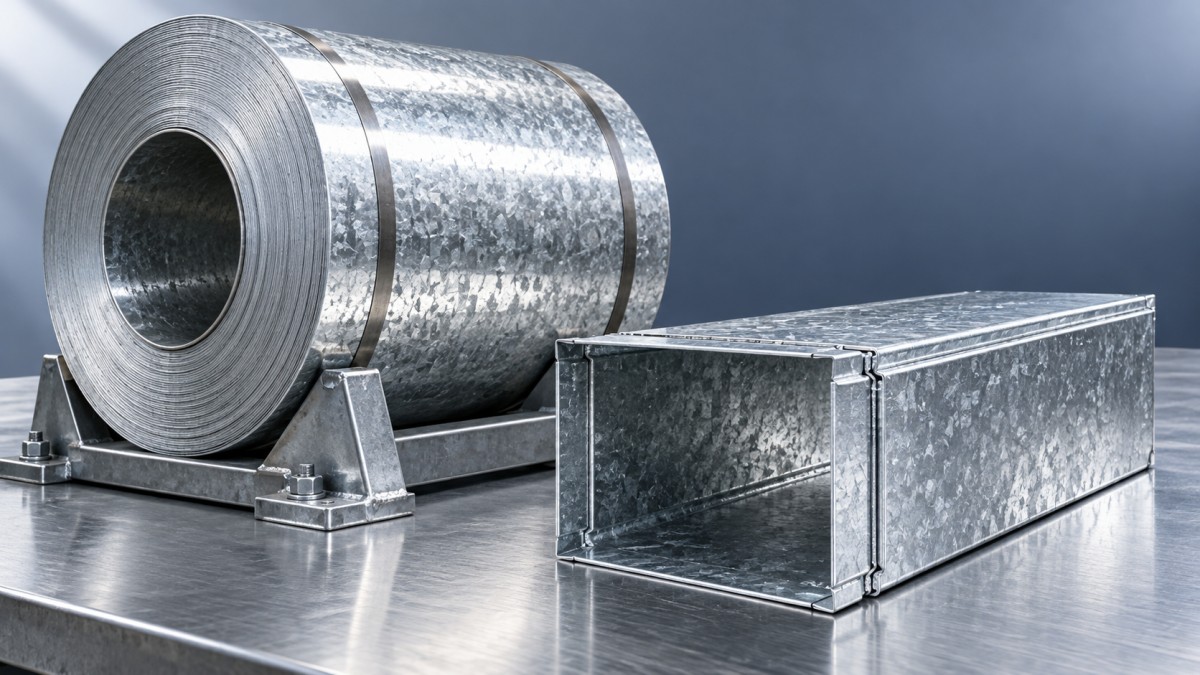
The word “galvanized” does not define the amount of zinc on the sheet. Specify a coating designation under the selected product standard and make clear how that designation is expressed. Coating systems can use different units and conventions, so similar-looking descriptions from different standards should not be treated as equivalent.
For continuously hot-dip galvanized sheet, coating mass designations commonly relate to the combined coating on both faces. They should not be read as the coating thickness on each face. If surface-specific requirements matter, include them explicitly rather than assuming equal distribution.
Select the coating with the exposure and fabrication process in mind. A heavier coating provides a larger zinc reserve under comparable conditions, but it can also make demanding bends more sensitive to tooling and coating behavior. The useful specification is one that achieves the required protection and forms reliably into the finished duct.
Spangle appearance is a separate issue. A prominent crystalline pattern does not prove that a sheet has more zinc or better corrosion resistance. Where appearance matters on exposed ductwork, specify the required surface finish separately from coating mass.
Cut edges, drilled holes, and welded areas also need attention. Zinc can provide local protection near small exposed edges, but this should not be treated as unlimited protection for damaged or extensively exposed steel. Define acceptable coating damage and the repair procedure for fabrication and installation.
Surface condition affects sealing, painting, and storage
Surface treatment can influence work well beyond the forming line. Oiling and chemical treatments may help protect coils during transport and storage, but residues can affect the adhesion of duct sealants, tapes, paints, and bonded insulation. Specify the intended downstream processes so that the supplied surface condition is compatible with them.
If ductwork will be painted, establish a suitable preparation and coating system for galvanized surfaces. “Paintable” is too vague unless it connects to a defined cleaning and preparation method. Similarly, confirm sealant compatibility using the actual sheet surface, including its treatment and any forming lubricant.
Storage conditions can undermine otherwise suitable material. Moisture trapped between tightly wound layers may cause wet storage staining, often seen as white deposits. Keep coils dry, protect them from standing water and weather, and manage condensation when cold material enters a warmer building.
White staining and red rust should not be treated as identical findings. White deposits can indicate zinc corrosion, while red rust indicates exposed steel corrosion. Disposition should consider the extent of the damage, the remaining coating, and the intended finish. Heavy deposits should not be accepted solely because the steel beneath is still covered.
Match coil dimensions to the fabrication line
A coil can satisfy the material requirements and still be unsuitable for production. Width affects blank layouts, cutting waste, and available duct dimensions. Inside diameter must suit the decoiler mandrel, while outside diameter and coil mass must remain within equipment and handling limits.
Confirm these limits with the fabricator before ordering. Large coils can reduce changeovers, but that advantage disappears if lifting equipment cannot handle them or if the decoiler cannot support them safely. Smaller coils may suit constrained workshops, although they create more handling and loading operations.
Dimensional consistency matters as much as the stated size. Camber, edge wave, coil set, and damaged edges can interfere with feeding, alignment, and seam formation. Specify the relevant tolerances under the chosen product standard, with additional fabrication requirements where necessary.
For slit coils, define width tolerance and acceptable edge condition. Burrs can create handling hazards and interfere with joints. Require identification to remain traceable after slitting, so each supplied coil can be linked to its material documentation.
Keep sheet purchasing distinct from related mechanical materials. Items such as Galvanized Pipe may appear elsewhere in the same project, but their specifications do not establish the grade, coating, or thickness required for duct sheet.
Turn the requirements into a usable purchase specification
The purchase description should let the supplier quote accurately and let receiving staff determine whether the delivery complies. Avoid descriptions that combine a precise thickness with vague requirements such as “good quality zinc coating.” The following items belong in the order or its referenced material schedule.
Require documentation that identifies the supplied material and reports the properties needed by the specification. A certificate is useful when it can be matched to the coil label and purchase order. Establish how split coils and partial deliveries retain that connection.
Processing capability also belongs in supplier discussions. Jiangsu Zhongersheng Metal Products Co., Ltd. supplies galvanized sheets and coils and provides processing services including cutting, bending, and punching. When evaluating supply arrangements, define which operations occur before delivery and which remain with the duct fabricator, since that division affects tolerances, packaging, and inspection.
Release production after a focused receiving check
At receipt, check coil identification against the order and documentation, inspect packaging and accessible surfaces for moisture or damage, and verify agreed dimensions using suitable methods. Thickness measurements need particular care when the requirement concerns base steel: a reading taken over the zinc coating does not directly establish base-metal thickness.
Hold material with unresolved identification, significant corrosion, or dimensions outside the agreed limits before it enters production. Once coils are slit or formed, separating affected material becomes more difficult and expensive.
For a new supply source or changed specification, combine receiving inspection with a short production trial. Check feeding, seam closure, flange formation, and surface condition after forming. Record the accepted material and machine settings so later deliveries can be assessed against a clear production reference.
Before placing the order, bring the approved duct construction schedule and the fabrication line’s limits into the same purchasing review. That is where thickness, coating, forming capability, and coil format become one workable specification—and where most avoidable material mismatches can be caught.
Please give us a message